

Did Jesus Go to Hell?
What the Creed Really Means When It Says He “Descended into the Underworld”


Deep Dive Podcast
Audio segment produced with AI narration summarizing Patrick Madrid’s written content.
A NUMBER OF callers to my radio show ask: What does the Creed mean when it says that the Lord “descended into hell? How could he go to hell?” For some, this seems to suggest the hell of the damned. But that is not what the Apostles’ Creed proclaims, and it is not what the Church has taught from the beginning.
Here is what Scripture reveals, what the Fathers—East and West—affirm, and what the Catholic Church continues to teach.
Jesus did not descend into the hell of the damned
Christ did not go to the state of final loss reserved for those who freely reject God.
“If your hand causes you to sin, cut it off; it is better for you to enter life maimed than with two hands to go to hell, to the unquenchable fire, where their worm does not die, and the fire is not quenched.”
Mark 9:43–48
That is the hell of unending separation from God. Souls arrive there only after what Scripture describes—with perfect bluntness—as the “exit interview” at death:
“It is appointed to a man to die once, and after that comes judgment.”
Hebrews 9:27
Jesus also identifies the destiny of the wicked:
“Depart from me, you cursed, into the eternal fire prepared for the devil and his angels.” Matthew 25:41
The Catechism states the distinction directly:
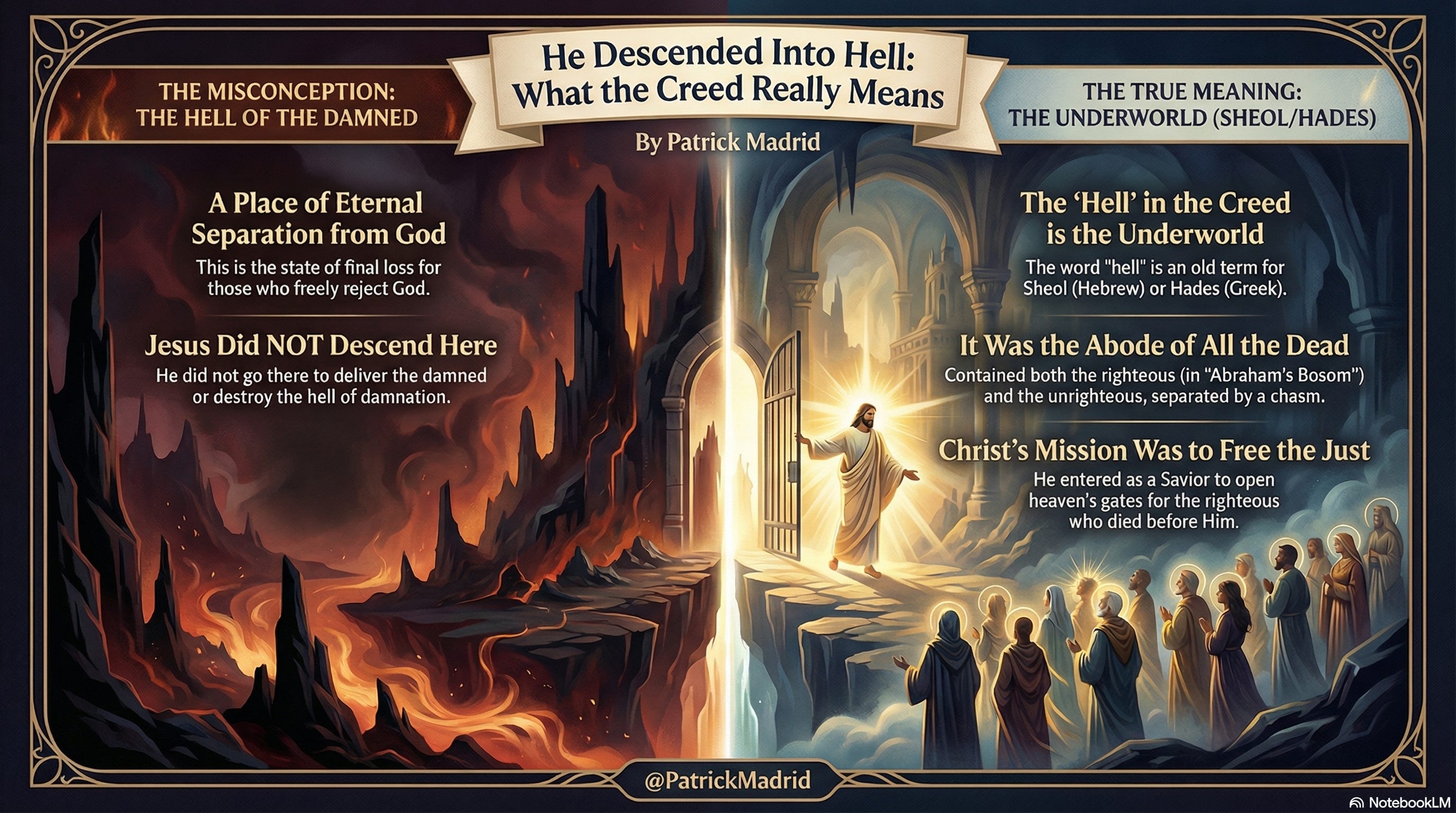
“Jesus did not descend into hell to deliver the damned, nor to destroy the hell of damnation, but to free the just who had gone before Him.” CCC 633
This fact alone rules out the idea, found only in certain modern Protestant teachers, that Jesus went to the place of eternal punishment.
What the Creed actually names: the underworld of Sheol and Hades
When the Apostles’ Creed says He “descended into hell,” the English word hell reflects older usage. It once functioned as a general term for the underworld, translating Sheol (Hebrew) and Hades (Greek), the place where the dead dwelt before Christ’s resurrection.
Jesus gives the clearest description of Sheol/Hades in Luke 16:
“There was a rich man, who was clothed in purple and fine linen and who feasted sumptuously every day. And at his gate lay a poor man named Lazarus, full of sores . . .
“The poor man died and was carried by the angels to Abraham’s bosom. The rich man also died and was buried; and in Hades, being in torment, he lifted up his eyes, and saw Abraham far off and Lazarus in his bosom.
And he called out, ‘Father Abraham, have mercy upon me, and send Lazarus to dip the end of his finger in water and cool my tongue; for I am in anguish in this flame.’
But Abraham said, ‘Son, remember that you in your lifetime received your good things, and Lazarus in like manner evil things; but now he is comforted here, and you are in anguish.
And besides all this, between us and you a great chasm has been fixed, in order that those who would pass from here to you may not be able, and none may cross from there to us.’
And he said, ‘Then I beg you, father, to send him to my father’s house, for I have five brothers, so that he may warn them, lest they also come into this place of torment.’
But Abraham said, ‘They have Moses and the prophets; let them hear them.’
And he said, ‘No, father Abraham; but if someone goes to them from the dead, they will repent.’
He said to him, ‘If they do not hear Moses and the prophets, neither will they be convinced if someone should rise from the dead.’” — Luke 16:22–31
Christ portrays two distinct regions in the underworld:
• A place of rest (“Abraham’s bosom”)
• A place of fiery anguish and punishment for the unrepentant
The Catechism affirms this ancient understanding:
“Scripture calls the abode of the dead, to which the dead Christ went down, ‘hell’—Sheol in Hebrew, or Hades in Greek—because those who were there were deprived of the vision of God.” CCC 633
The “Limbo of the Fathers,” East and West
This peaceful region, the abode of the Old Testament righteous people, was commonly called the “limbo of the fathers.”
St. Augustine: “The bosom of Abraham is understood to mean the secret place where the souls of the just rest before the resurrection.”
Letter 164
St. Jerome: “Before the coming of the Savior, all who died were held in one place, though there was a distinction between the faithful and the unfaithful.”
Commentary on Ecclesiastes
St. Gregory the Great: “He who appeared on earth descended to the lower parts to liberate the souls of the righteous.” Homilies on the Gospels 29
St. Ephrem the Syrian: “Death trembled when He entered and shattered its belly. He opened the tombs and made the dead rejoice.”
Hymns on the Resurrection
St. Cyril of Jerusalem: “He delivered the righteous dead who had been shut up in Hades.” Catechetical Lectures 14.19
The Catechism expresses the same doctrine:
“Jesus, like all men, experienced death and in His soul joined the others in the abode of the dead. But He descended there as Savior.” CCC 632
Christ brings the Good Thief with Him
On Good Friday, Jesus assures the repentant thief:
“Truly, I say to you, this day you will be with me in paradise.” Luke 23:43
His descent into the underworld is the beginning of that promise fulfilled.
The Old Testament righteous waited for Him
Hebrews describes their long anticipation:
“These all died in faith, not having received what was promised, but having seen it and greeted it from afar.” Hebrews 11:13
“Apart from us they should not be made perfect.” Hebrews 11:40

Christ Alone Opens the Gates of Heaven
St. Paul is clear:
“There is one mediator between God and man, the man Christ Jesus.”
1 Timothy 2:5
And the Catechism summarizes Christ’s mission in the underworld:
“By the grace of God Jesus tasted death for everyone… opening heaven’s gates for the just who had gone before Him.”
CCC 637
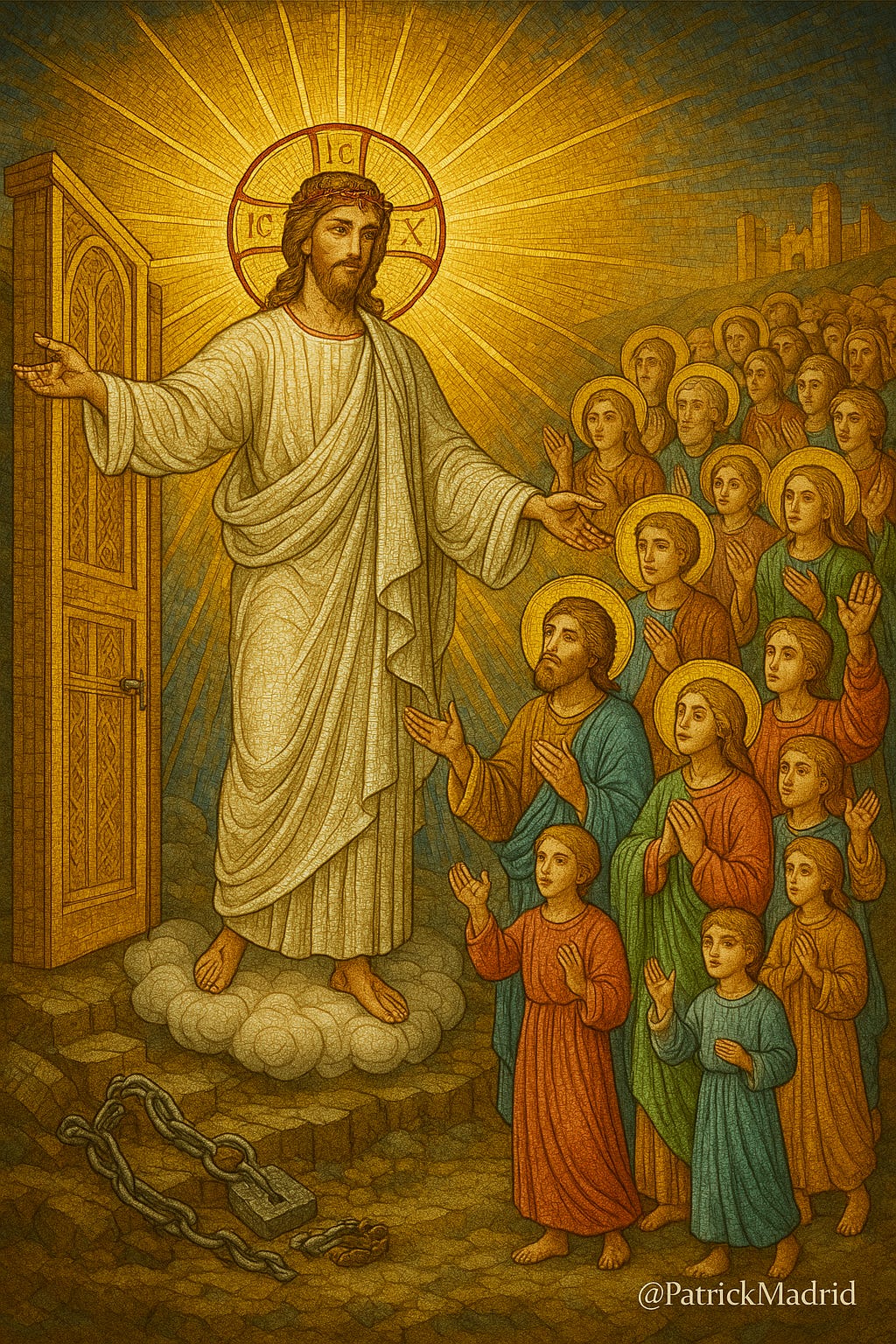
Christ preaches to the “spirits in prison”
St. Peter gives direct testimony:
“He went and preached to the spirits in prison, who formerly did not obey, when God’s patience waited in the days of Noah.” 1 Peter 3:19–20
“The gospel was preached even to the dead.” 1 Peter 4:6
Why some Protestants mistakenly claim Jesus suffered in the hell of the damned
A handful of modern Protestant teachers—Kenneth Copeland, Jimmy Swaggart, J. Vernon McGee, and others—taught that Jesus descended into the hell of the damned and endured its torments. This misunderstanding arose from two sources:
They did not use the historic creeds, which preserve the original meaning.
They misinterpreted St. Paul’s phrase that Christ “became sin.”
Let’s address that misinterpretation.
What “He became sin” really means
St. Paul writes:
“For our sake He made Him to be sin who knew no sin.” 2 Corinthians 5:21
Some assumed this meant Christ became sinful and therefore deserved the punishments of the damned. But that reading contradicts Scripture and the entire Christian tradition.
In biblical usage, “sin” (hamartia) often means sin offering. Christ becomes the sacrificial offering for sin—not a sinner Himself.
He does not become guilty of our sins.
He does not absorb moral corruption.
He does not enter the state of damnation.
He remains the spotless Lamb who bears the consequences of sin while remaining perfectly holy. This is why He declares just before His death: “It is finished” (John 19:30). If the atonement is complete on the cross, no further suffering in the hell of the damned follows.
The Catechism reinforces this point: “Christ did not go down into hell to deliver the damned, but to free the just who had gone before Him.” (CCC 633)
The Greek–Latin wording in the Creeds
The original languages make the meaning unmistakably clear.
Latin: Apostles’ Creed
descendit ad inferos
Not infernum (the hell of the damned), but inferos = “the lower regions,” meaning the underworld (Hades/Sheol).
Greek: early Nicene-Constantinopolitan forms
κατελθόντα εἰς τὰ κατώτατα
“He descended to the lower regions.”
In some early forms: εἰς ᾅδου — “into Hades.”
The Catechism summarizes:
“The term ‘hell’ here does not mean the hell of the damned, but the abode of the dead into which Jesus entered.” CCC 633
A brief word about the English variant: “He descended to the dead”
Some English-speaking Christians encounter a modernized wording: “He descended to the dead.” This formula is not incorrect, but it is somewhat incomplete.
It avoids the common misunderstanding that Jesus entered the hell of the damned. Yet it does not convey the full biblical meaning of Sheol and Hades, the underworld where both the righteous and the unrighteous awaited final redemption.
Saying “He descended to the dead” affirms that Jesus truly entered the state of death and the underworld. But the traditional wording expresses more: that He entered their domain, proclaimed His victory, shattered the ancient captivity, and led the righteous into the presence of God.
As the Catechism puts it:
“Jesus, like all men, experienced death and in His soul joined the others in the abode of the dead. But He descended there as Savior” (CCC 632). He did not merely join “the dead.” He entered their realm with power.
What the Fathers and Doctors teach
St. Irenaeus: “The Lord descended into the regions beneath the earth, preaching His coming and the remission of sins for those who believe in Him.”
Against Heresies V.31.1
St. Cyril of Alexandria: “He opened for the souls in Hades a new and living way.” Commentary on John
St. John Damascene: “He did not descend to suffer, but to release the prisoners and to proclaim liberty to the captives.” Exposition of the Orthodox Faith III.29
St. Thomas Aquinas: “Christ’s descent was to release the just from their place of waiting.” Summa Theologiae III, q. 52, a. 1
No Father—Latin or Greek—ever taught that Christ suffered in the hell of the damned.
“The gates of Hades will not prevail”
A clearer understanding of Jesus’ teaching about Lazarus and the rich man sheds new light on one of His most famous promises to the Church.
In Luke 16, both men are in Sheol / Hades / the underworld, though in radically different conditions. That shared setting matters, because Jesus later says:
“And I tell you, you are Peter, and on this rock I will build my church, and the gates of Hades shall not prevail against it.”
Matthew 16:18
The Greek is explicit:
πύλαι ᾅδου οὐ κατισχύσουσιν αὐτῆς (pýlai hādou ou katiskhýsousin autēs)
“The gates of Hades will not prevail against it.”
We often hear this verse and assume it means that hell will never overpower the Church, as though the Church were a kind of impregnable fortress under siege. But notice the image Jesus uses. Gates are defensive, not offensive. No one attacks an enemy with gates.
Jesus is not portraying the Church so much as a bunker or an impregnable fortress barely holding out against the devil. Rather, He is describing His own and the Church’s assault on the underworld itself. The gates of Hades are the barriers that keep the dead confined. And they will not hold.
That promise finds its dramatic fulfillment when Christ Himself descends into Sheol. His entry into the underworld shatters death’s gates, not by force of arms, but by the overwhelming power of truth, grace, and life. Death cannot bar its doors against the Author of Life.
Seen in this light, the Church is not merely protected from hell. Christ storms hell. He breaks its gates. He sets the captives free.
And the Church He builds on the rock of Peter continues to proclaim that same victory to the world.
This is not the image of a frightened Church hiding from evil. It is the image of a triumphant Christ, whose descent into the underworld proves that even the gates of death itself cannot withstand Him.
Conclusion
When you next recite the Apostles’ Creed and announce that Jesus “descended into hell,” you can do so with clarity. Jesus did not enter the hell of the damned. He descended to the underworld—the realm of Sheol and Hades—to proclaim His triumph, free the righteous of old, and lead them into the presence of God.
This is the Harrowing of Hell.
This is the triumph of the Cross.
This is the victory the first Christians proclaimed without hesitation.
And this is what those seven words in the Creed truly mean.
Copyright © 2025 Patrick Madrid. All rights reserved. All text, images, and other original content are the property of the author.
I hope you enjoy my articles here. If so, please tap the Share button above to post any of them on X or Instagram or to send it to someone who might be interested in it. And if you enjoy thoughtful, friendly, faith related content, you’ll appreciate my daily program on Relevant Radio. Listen here or get the free Relevant Radio app.
