

Once Saved Always Saved? Not According to the Bible
Why the Notion of Eternal Security Collapses Under Biblical Scrutiny

Deep Dive Podcast
Audio segment produced with AI narration summarizing Patrick Madrid’s written content.
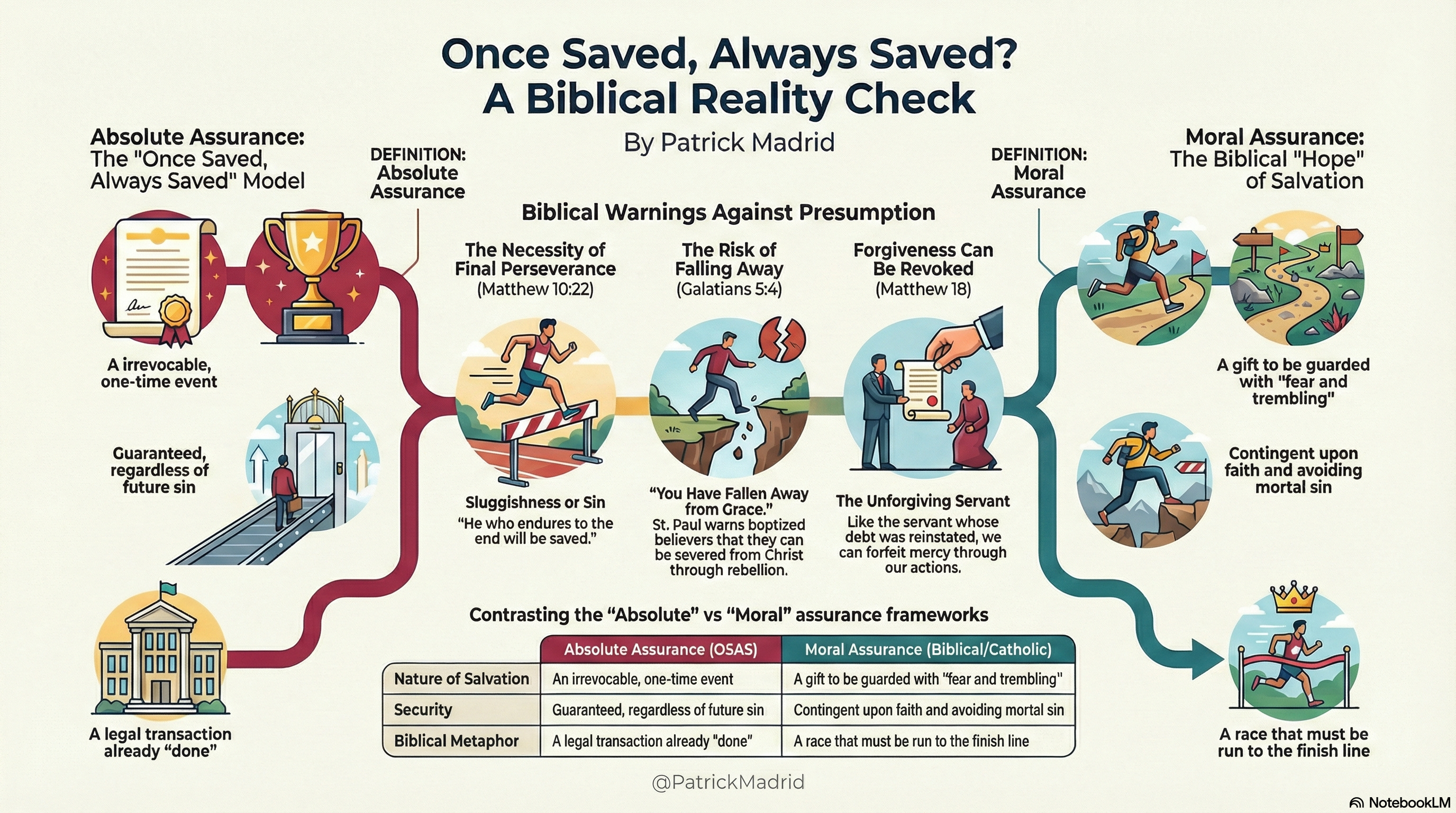
MANY PROTESTANTS understand being “saved” as a one-moment-in-time act of repentance and acceptance of Jesus Christ as one’s “personal Lord and Savior” a phrase that nowhere appears in the Bible, by the way a life-changing transformation of a “lost” sinner who becomes a “saved” child of God. They believe this to be an irrevocable step that eliminates the penalties of past sins and guarantees, no matter what might happen from that point forward, that nothing can undo or rescind one’s salvation.
“Once saved, always saved” is a slogan many Protestants use to describe their belief in a Christian’s absolute assurance of salvation. And though not all Protestants accept the once-saved-always-saved formula, huge swathes of Protestantism, such as Southern Baptists and the myriad of the evangelical “non-denominational” denominations that are heavily influenced by the Baptist belief system do.
Baptists tend to emphasize a “do/done” approach to salvation. You say the sinner’s prayer, accept Jesus Christ as your personal Lord and Savior, and your salvation is “done,” accomplished by God’s free gift of grace.
Calvinists reach the same conclusion but through their understanding of God’s sovereign decrees predestining some to eternal life and double-predestining the rest of mankind, the reprobates, to eternal damnation (some describe it in terms of God electing some to salvation while passing over the rest who are then justly condemned for their sins). In both cases the practical takeaway is the same: Eternal Security of salvation that cannot be lost through personal sin.
Calvinists and those within Protestantism who have been heavily influenced by Calvinism (even though they may eschew the label because they reject a “Presbyterian” system that includes infant baptism, a quasi-liturgical approach to Sunday worship, and particular models of local church government) also believe in “eternal security” or “once saved always saved,” even if their systematic route to that conclusion differs and they describe it in different terms.
The Catechism of the Catholic Church summarizes the Church’s teaching on salvation and that we do indeed have a moral assurance of salvation, no Christian as an absolute assurance:
“Although no one can know by himself that he is in the state of grace, at least not with certainty, yet there are signs that permit us to have moral assurance in accordance with the words of the Lord: ‘Thus you will know them by their fruits’ (Matthew 7:20).” CCC 2005
“There are two kinds of presumption. Either man presumes upon his own capacities, . . . or he presumes upon God’s almighty power or his mercy, . . . and obtains forgiveness without conversion and glory without merit.” CCC 2092
“To die in mortal sin without repenting and accepting God’s merciful love means remaining separated from him forever by our own free choice.” CCC 1033
“We can therefore hope in the glory of heaven promised by God to those who love him and do his will. In every circumstance, each one of us should hope, with the grace of God, to persevere “to the end” and to obtain the joy of heaven, as God’s eternal reward for the good works accomplished with the grace of Christ. In hope, the Church prays for “all men to be saved.” She longs to be united with Christ, her Bridegroom, in the glory of heaven.” CCC 1821
“The children of our holy Mother the Church rightly hope for the grace of final perseverance.” CCC 2016
“When God reveals Himself and calls him, man cannot fully respond to the divine love by his own powers. He must hope that God will give him the capacity to love Him in return and to act in conformity with the commandments of charity. Hope is the confident expectation of divine blessing and the beatific vision of God; it is also the fear of offending God’s love and of incurring punishment.” CCC 2090
“ The first commandment is also concerned with sins against hope, namely, despair and presumption: By despair, man ceases to hope for his personal salvation from God, for help in attaining it or for the forgiveness of his sins. Despair is contrary to God’s goodness, to his justice - for the Lord is faithful to his promises - and to his mercy.” CCC 2091
“There are two kinds of presumption. Either man presumes upon his own capacities, (hoping to be able to save himself without help from on high), or he presumes upon God’s almighty power or his mercy (hoping to obtain his forgiveness without conversion and glory without merit).” CCC 2092
Now let’s consider the Bible passages commonly cited in support of the idea of an absolute assurance of salvation and see why none of them actually teaches that:
John 6:37–40
“All that the Father gives me will come to me, and him who comes to me I will not cast out. For I have come down from heaven, not to do my own will, but the will of him who sent me; and this is the will of him who sent me, that I should lose nothing of all that he has given me, but raise it up at the last day. For this is the will of my Father, that every one who sees the Son and believes in him should have eternal life; and I will raise him up at the last day.”John 10:27–29
“My sheep hear my voice and I know them, and they follow me; and I give them eternal life, and they shall never perish, and no one shall snatch them out of my hand. My Father, who has given them to me, is greater than all, and no one is able to snatch them out of the Father’s hand.”Romans 8:28–30
“We know that in everything God works for good with those who love him, who are called according to his purpose. For those whom he foreknew he also predestined to be conformed to the image of his Son, in order that he might be the first-born among many brethren. And those whom he predestined he also called; and those whom he called he also justified; and those whom he justified he also glorified.”Ephesians 1:13-14
“In him you also, who have heard the word of truth, the gospel of your salvation, and have believed in him, were sealed with the promised Holy Spirit, which is the guarantee of our inheritance until we acquire possession of it, to the praise of his glory.”Philippians 1:6
“And I am sure that he who began a good work in you will bring it to completion at the day of Jesus Christ.”1 Peter 1:3-5
“Blessed be the God and Father of our Lord Jesus Christ! By his great mercy we have been born anew to a living hope through the resurrection of Jesus Christ from the dead, and to an inheritance which is imperishable, undefiled, and unfading, kept in heaven for you, who by God’s power are guarded through faith for a salvation ready to be revealed in the last time.”Jude 24
“Now to him who is able to keep you from falling and to present you without blemish before the presence of his glory with rejoicing . . .”1 John 5:13
“I write this to you who believe in the name of the Son of God, that you may know that you have eternal life.”
Saint John’s assurance that “you have eternal life” is a proclamation of every Christian’s moral not absolute assurance of salvation. Christ offers us the gift of salvation, and he will not go back on his word.
Note that these passages speak of God’s promise being trustworthy, but also that you and I are entirely capable of going back on our promises by abandoning Christ and, thereby, forfeiting his gift of salvation.
For example, notice St. Paul’s conditional if/then nature of this teaching about salvation:
2 Timothy 2:11–13
“If we have died with him, we shall also live with him; if we endure, we shall also reign with him; if we deny him, he also will deny us; if we are faithless, he remains faithful for he cannot deny himself.”
The “if” in this passage makes clear that while it’s true that one may indeed “have” salvation, whether or not one keeps his grasp on it is another matter, as the other passages we’ll consider briefly below demonstrate.
But first, let’s consider Saint John’s other statement: No one can snatch out of Christ’s hand those whom the Father has given him. No external power is capable of wresting us out of Christ’s loving embrace, but you can do it if you decide to willfully rebel against God through mortal sin, and if you die unrepentant in that state, you will have lost your salvation because you will have, in effect, snatched yourself out of Christ’s hand.
This reality is clearly demonstrated by the following verses. First, the Lord Himself warns:
Matthew 7:21–23
“Not every one who says to me, ‘Lord, Lord,’ shall enter the kingdom of heaven, but he who does the will of my Father who is in heaven.”Matthew 10:22
“He who endures to the end will be saved.”John 5:29
“Those who have done good will rise to the resurrection of life, and those who have done evil to the resurrection of judgment.”
The Lord’s emphasis on enduring “to the end” closely resembles a longer warning God gave to His people in the Old Covenant. This is a clear reminder that you can always count on God to keep His promises, because He is always faithful. However, you can be (and let’s face it, most people often are) unfaithful and lose God’s gift of salvation:
Ezekiel 18:24
“But when a righteous man turns away from his righteousness and commits iniquity, and does the same abominable things that the wicked man does, shall he live? None of the righteous deeds which he has done shall be remembered. For the treachery of which he is guilty and the sin he has committed, he shall die.”Ezekiel 33:12–13
“And you, son of man, say to your people: The righteousness of the righteous shall not deliver him when he transgresses. And as for the wickedness of the wicked, he shall not fall by it when he turns from his wickedness, and the righteous shall not be able to live by his righteousness when he sins. Though I say to the righteous that he shall surely live, yet if he trusts in his righteousness and commits iniquity, none of his righteous deeds shall be remembered, but in the iniquity that he has committed he shall die.”
Saint Paul says:
Romans 2:5–11
“He will render to every man according to his works.”
And he adds:
Romans 8:24–25
“For in this hope we were saved. Now hope that is seen is not hope.”
Next, he applies this warning to himself:
1 Corinthians 9:27
“I pommel (i.e., buffet, beat) my body and subdue it, lest after preaching to others I myself should be disqualified.”
Disqualified from what? From salvation, as he makes clear in the preceding verses (24-26) speaking of winning the “prize,” the “imperishable wreath,” that only those who finish the race can obtain. Obviously, those who begin the race but fail to finish it cannot obtain the prize. This is echoed by the Lord’s own teaching:
Matthew 10:22 (24:13)
“He who endures to the end will be saved.”
In other words, you may receive salvation, the equivalent of beginning to run the race, but then drop out through fatigue, laziness, disbelief, diversion into sin, etc., and not endure to the end. Only those who do endure, Jesus says, will be saved.
St. Paul reiterates this warning about the potential to lose salvation:
1 Corinthians 10:12
“Let any one who thinks that he stands take heed lest he fall.”
In the next chapter he gives an extended, pointed warning about the real possibility of losing one’s salvation:
Romans 11:20–22
“That is true. They were broken off because of their unbelief, but you stand fast only through faith. So do not become proud, but stand in awe. For if God did not spare the natural branches, neither will he spare you. Note then the kindness and the severity of God: severity toward those who have fallen, but God’s kindness to you, provided you continue in his kindness; otherwise you too will be cut off.”
This warning to Gentile Christians (“ . . . otherwise you too will be cut off”) admonishes them not to become like those individual Jews living at the time of Christ who forfeited their salvation by deliberately rejecting Jesus Christ as Messiah, Redeemer, and Savior. These Jews were once “branches” on the cultivated olive tree symbolizing those who were saved in Israel. In other words, he is here warning the Gentile Christians not to lose their salvation and be among those whose branches were “broken off.”
This warning dovetails with a similar warning St. Paul delivers to baptized believers who had “begun with the Spirit” (Gal. 3.3) . . .
Galatians 5.4
“You are severed from Christ, you who would be justified by the law; you have fallen away from grace.”
See my explanation of this passage here. Notice also the similar warning in the Epistle to the Hebrews :
Hebrews 6:11–12
“So that you may not be sluggish, but imitators of those who through faith and patience inherit the promises.”
The plain meaning is clear: Those who are sluggish and not patient in their endurance will not inherit the promise (not guarantee) of salvation.
Luke 21:19
“By your endurance you will gain your lives.”Romans 2:6–7
“For he will render to every man according to his works: to those who by patience in well-doing seek for glory and honor and immortality, he will give eternal life.”
Next, consider this next warning given to those who have 1) received the truth and 2) have been sanctified by the blood of the Covenant that Jesus shed on the cross for the salvation of many (see Matthew 26:28).
There is no way someone can be “sanctified” by the covenant blood of Christ apart from being regenerated and justified by God’s grace. In other words, by having received the gift of salvation, which he can clearly forfeit:
Hebrews 10:26–31
“For if we sin deliberately after receiving the knowledge of the truth, there no longer remains a sacrifice for sins, but a fearful prospect of judgment, and a fury of fire which will consume the adversaries. A man who has violated the law of Moses dies without mercy at the testimony of two or three witnesses. How much worse punishment do you think will be deserved by the man who has spurned the Son of God, and profaned the blood of the covenant by which he was sanctified, and outraged the Spirit of grace? For we know him who said, ‘Vengeance is mine, I will repay.’ And again, ‘The Lord will judge his people.’ It is a fearful thing to fall into the hands of the living God.”
If there were no possibility of losing one’s salvation, why would St. Paul urge believers to:
Philippians 2:12–13
“Work out your own salvation with fear and trembling.”
What would there be to fear if you have an absolute assurance of salvation?
1 John 3:21–24
“Whoever keeps his commandments abides in him.”
What if you start well but then fail to keep his commandments?
1 John 4:20–21
“He who does not love his brother whom he has seen, cannot love God whom he has not seen.”
St. Peter adds another warning:
2 Peter 2:20–21
“For if, after they have escaped the defilements of the world through the knowledge of our Lord and Savior Jesus Christ, they are again entangled in them and overpowered, the last state has become worse for them than the first.”
Ask yourself: Is there any way someone could “escape the defilements of the world” other than by God’s grace and forgiveness, what many refer to as being “saved”? No. So this means that some who have been saved fall back into grievous sin, thereby losing their salvation.
And finally, recall the unforgiving servant in Matthew 18:21–35. The analogy the Lord uses here is the cancelation of a debt corresponds to receiving the gift of salvation, a gift we don’t deserve but which God gives us in Christ through faith, repentance and obedience (see John 3:16, 36; 5:24; Romans 1:5, 2:6-8, 6:16, 16:260).
In this parable, the servant pleads for mercy because he cannot repay his debt. This corresponds to the repentant sinner who pleads for mercy and is forgiven by God, with his debt of sin wiped out by Jesus Christ’s saving sacrifice on the cross. But in the parable, after being forgiven his debt, the man proceeds to mistreat a fellow servant, demanding that he pay a far smaller sum that he owes. The Unforgiving Servant shows no mercy and, when the king discovers this hardheartedness, he reinstates the servant’s entire debt and throws him into prison.
Then the Lord then adds a chilling warning for us:
Matthew 18:35
“So also my heavenly Father will do to every one of you, if you do not forgive your brother from your heart.”
The Bible is clear that, tragically, Christians can indeed lose their salvation by sinful rebellion against God. (Check out another article I wrote on this topic.)
Finally, ask yourself: Why would Christ warn about this if there were no danger that it could actually happen?
Copyright © 2004-2026 Patrick Madrid. All rights reserved. Adapted and expanded from my 2004 article “Yes, Christians Do Have an Assurance—but Not an Absolute Assurance—of Salvation.” All text, images, and other original content are the property of the author.
I hope you enjoy my articles here. If so, please tap the Share button above to post any of them on X or Instagram or to send it to someone who might be interested in it. And if you enjoy thoughtful, friendly, faith related content, you’ll appreciate my daily program on Relevant Radio. Listen here or get the free Relevant Radio app.

I don’t know how Protestants can justify the “once saved always saved” theory after so many scripture verses tell us otherwise. Luther wanted to remove the letter of James precisely because James preached about works being necessary for salvation (Faith without works is dead). If you believe this error, then works don’t matter. Thank you, Patrick!
Thank you for this! I recently quoted Hebrews 10:26- 31 to someone who insisted "once saved, always saved. " His response was " those are Paul's words, not Jesus'"
Some folks feel they can debate the words inspired by the Holy Spirit.