

What I Learned From an Angry Ex-Catholic
The Unexpected Power of Listening Instead of Defending

Deep Dive Podcast Discussion:
Audio segment generated with AI narration summarizing Patrick Madrid’s written content.
I HAVE FOUND that sharp criticism of the Catholic Church often masks deeper, unseen and unresolved wounds a person carries. Something is going on beneath the surface. The person may be carrying anger toward the Church and feels compelled to keep taking potshots at it. I’ve met people like this. I’ve known people like this. Perhaps you have, too.
One sad reality of human nature is that we sometimes lash out at others when trying to cover up or deflect attention from a wound or struggle within ourselves. When someone attacks the Faith, there may be a deeper, unspoken reason at work. Defending the Faith against their anger seldom helps. But listening carefully can reach places arguments never will.
Let me tell you a true story that illustrates what I mean.
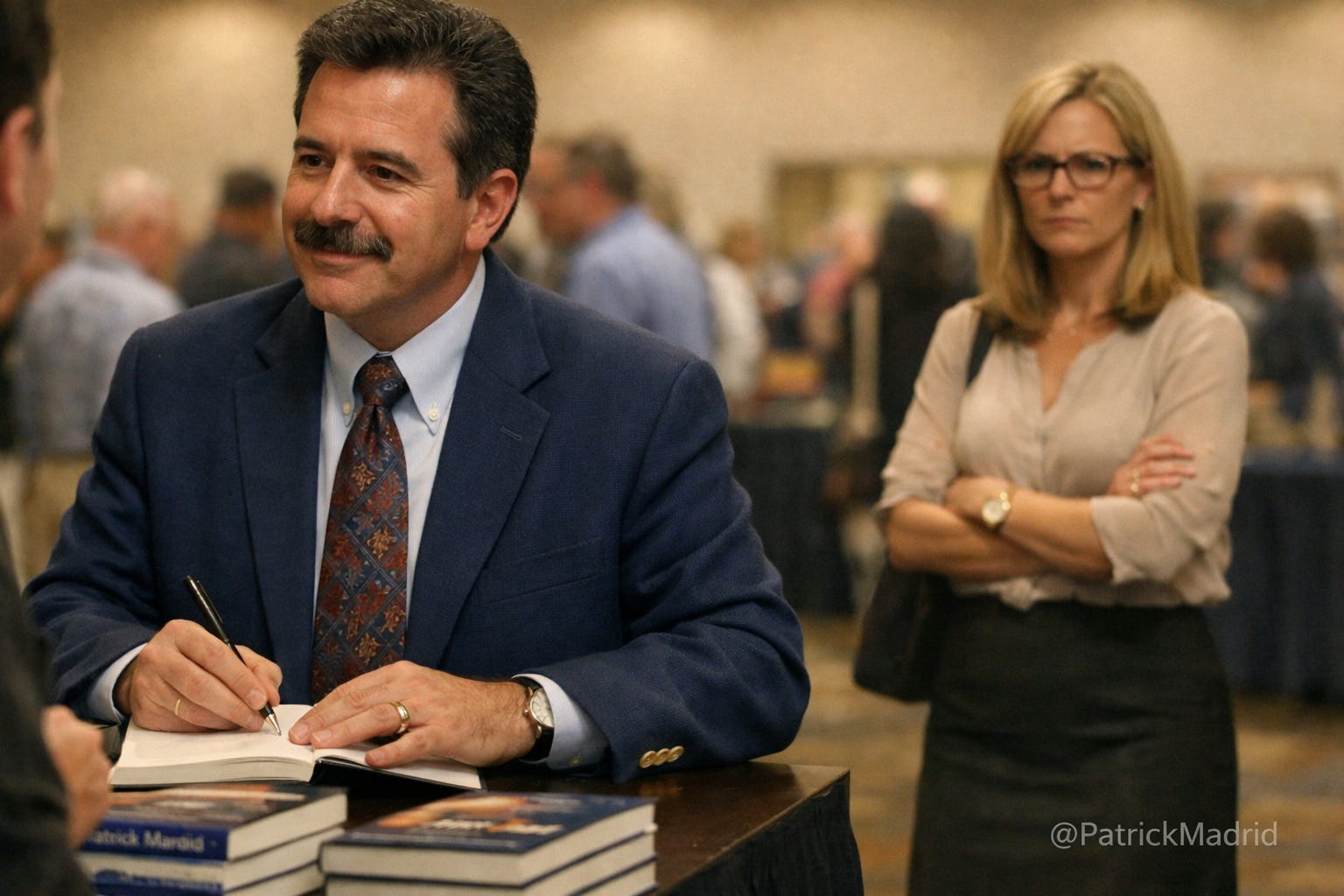
I was speaking in Florida at a big Catholic conference with multiple presenters. I had given my first talk and was back at my book table, signing books and meeting people. Out of the corner of my eye, I noticed a woman in her late thirties standing about ten feet away, scowling.
Every so often as I signed books, I’d glanced over. Still there. Still scowling. She was waiting until the last person left.
When the time came, I smiled and said hello.
Her response was immediate.
“Don’t even try it.”
Excuse me? I thought as I turned toward her. All I said was “hello.” What do you mean, “don’t even try it”? Try what? Her next words explained it.
“I know what you do,” she frowned, gesturing toward the stacks of my books on the table.
“I know that you’re all about trying to get people to become Catholic. Well, I’m an ex-Catholic” (emphasizing the ex for effect), and I don’t care if you don’t want to hear it, but there’s no way I would ever go back.”
I remember thinking to myself, Well, then why are you even here?
She must have read my face, or perhaps she had anticipated the question.
“I’m only here at this conference because my husband, who’s Catholic, dragged me here,” she informed me curtly, crossing her arms in front of her. There was no husband around; he was probably browsing the book tables.
My guess is that she had heard my talk earlier that morning and was exasperated by it. The way she almost spat out the words made it clear she had had it up to here with the Catholic Church. So what’s the point of us even having a conversation?
In the split second it took to think this, as an awkward silence stretched on and the frown never left her face, another thought followed: Okay, lady. So why are you singling me out? Why wait to talk to me?
Then I noticed something else. I was starting to get angry. It doesn’t take much sometimes. This woman’s pushy, sarcastic, insulting comments about the Catholic Church were starting to get me a bit steamed.
“So . . .” I said leadingly, trying to stay relaxed and not look defensive, “you said you used to be Catholic. What happened?”
Tilting her head slightly and arching her eyebrows, she said, “Do you really want to know?”
“Yeah, sure.” But I wasn’t sure at all, and I immediately regretted giving her permission to unload the details of her unhappiness.

She launched into a familiar litany about how Catholics worship statues, Catholics worship Mary, Catholics think the wafer is really Jesus when it is just a piece of bread, Catholics think they can earn their salvation, and so on.
I’ve heard it all before. I tuned out, waiting to refute her.
Then something happened. I had what I can only describe as an intuition, a still, small voice. I don’t think it was God speaking to me. It could have been my guardian angel. But I perceived a clear interior instruction: zip it. Be quiet.
I remember thinking, Where did that come from? Because that is not my modus operandi. That is not how I usually operate.
So I decided to follow it.
When she finished her diatribe, I said nothing. I just stood there.
For a moment, I thought, Oh boy, she thinks I do not have an answer. That was a blow to my pride, and my pride certainly deserves many blows. But I kept quiet anyway, against every instinct I had.
She stared, waiting for my rebuttal.
I said, “You used to be Catholic.”
“Yes,” she said, her eyes guarded.
“Well,” I continued, tentatively, “what happened?”
Still frowning, she paused for a long moment and said nothing.
“What happened?” I asked again, as gently as I could.
Something almost imperceptible had changed. A lot of the anger seemed to go out of her, as if the proverbial wind went out of her sails now that she had unloaded all her complaints.
We sat down at a nearby table in the convention center, where there was nobody around for twenty or thirty feet. She put her purse on the table. She sat across from me.
She said, “Here’s what happened.”
She told me she had been raised in a big, devout Catholic family. Her parents were strict Catholics, she said, emphasizing “strict” more than once. Sunday Mass. The Rosary. Catholic grammar school. Catholic high school.
Then she paused.
A single tear trickled down her cheek.
“When I was eighteen . . .”
She paused, her hand rising to her mouth for a moment and then wiped away the tear, “When I was eighteen, just after graduating from high school, I got pregnant.”
There was no need for her to add that she was not married.
Then the whole story tumbled out. Almost as if she was not really telling me what had happened that unhappy summer, but rehearsing aloud what had been looping in her own mind, reliving the shock, pain, and embarrassment all over again.
Her boyfriend pressured her to have an abortion, she told me. Her parents, she was certain, would have flipped out at even the suggestion that she keep the baby. They would be ashamed. Their “super-duper” Catholic daughter from that big, respectable Catholic family had gotten herself into trouble and brought shame on herself and on the whole family.
She could not tell her parents. She could not tell her brothers and sisters. Her boyfriend was pushing abortion. She did not know where to turn. And it was urgent, because she would soon start showing.
So she went to a Catholic parish a couple of towns over, where nobody knew her. Without an appointment, she walked into the parish office and asked to see the priest. The boyfriend waited in the car at the curb.
She was nervous. She was an emotional wreck. The priest stepped out of his office and said, “Yeah, what’s up?”
She told him, through her fear and confusion, that she was single, pregnant, Catholic, and did not know what to do. She said she needed help.
I could see the pain rising in her eyes as she recounted how disinterested and rushed the priest had been in responding to her plight.
“Well, you know, pregnancy tests are often inaccurate,” he told her. “It may be nothing after all. Don’t worry. Just take another test next week.” His demeanor and bland response made it clear to her that he didn’t really care. He even told her, she added, that he was very busy and didn’t have time. He had other things to do. And then he shooed her out of the office. It was staggering.
He didn’t pray with her. He didn’t refer her to a pro-life clinic. He did nothing to help her.
As she told me this, she began to cry again. I said nothing. I just listened, awkward and completely clueless about what I should say or do in that moment.
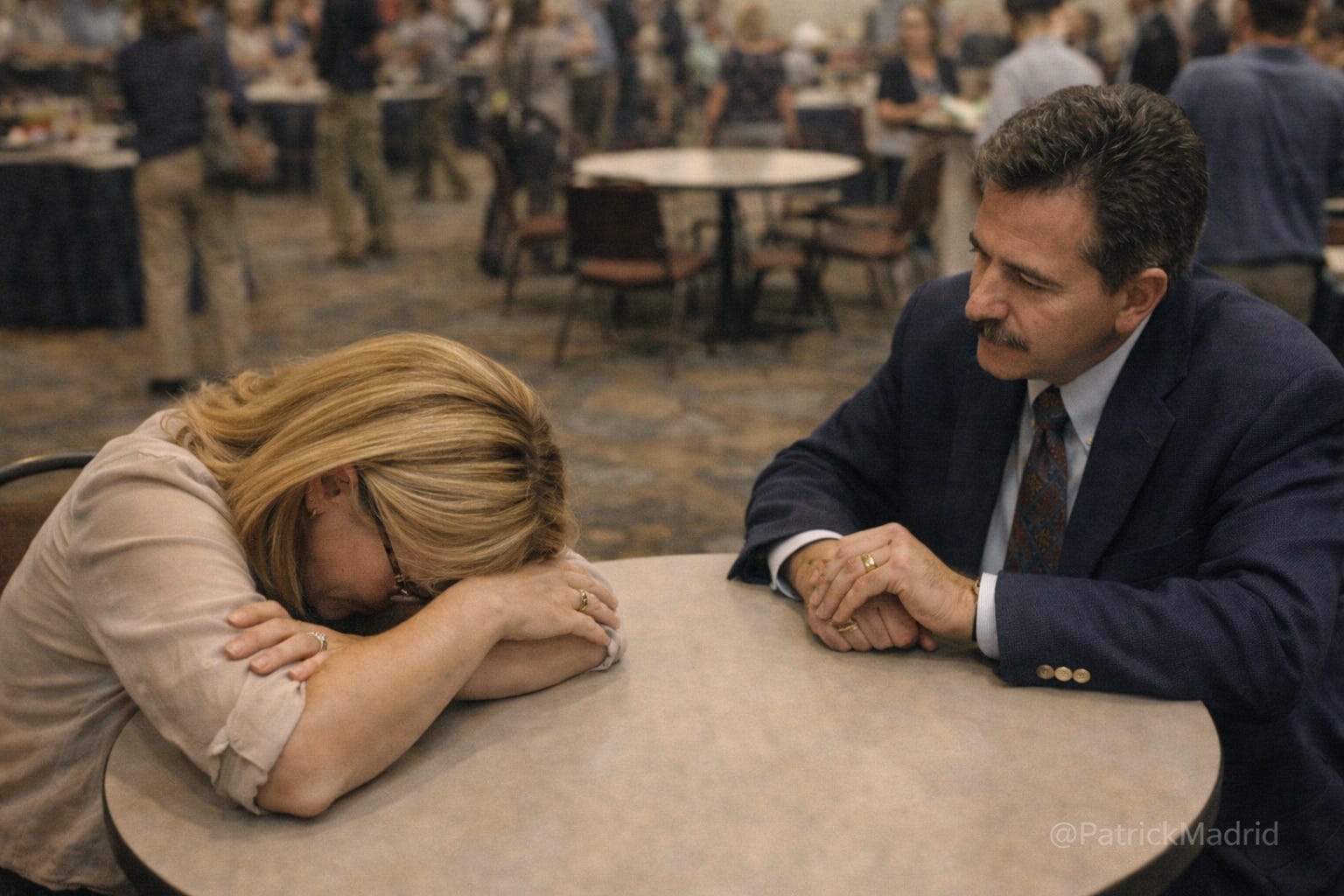
She put her head down on her arms, sobbing. Through her tears, she told me the only thing she felt she could do was have an abortion. The boyfriend paid the $300.
Now the woman who had been berating me about the Catholic Church just minutes earlier had her head down on the table, sobbing. Her shoulders were heaving. She could barely speak. I could only imagine how embarrassed she must be feeling just then as she fell apart in front of a stranger.
After a long moment, drying her eyes, she spoke again, her head still lowered.
“That’s when I started to hate the Catholic Church.”
Click. I suddenly realized what was happening.
She knew her parents wouldn’t help her. The priest wouldn’t help her. She felt she had no choice. She had to abort her baby.
Later, some of her Evangelical friends invited her to their church. She went. She felt a sense of relief at not having to face the members of her former parish. She quickly absorbed their antipathy toward things Catholic.
As she described it, calmly now, she turned her back on the Catholic Church completely. “That priest,” she said again and again, hadn’t helped her.
As I listened, it became clear that the priest had come to personify the Catholic Church for her. His woeful lack of pastoral concern became, in her mind, the Church’s refusal to help her. She left Catholicism with a vengeance.
Fast forward twenty or so years to now, as she was sitting across from me.
As she dried her tears and gathered herself, I blurted out the first thing that came to mind.
“You need to go to confession.”
She looked at me as if I had said, “Here, hold this rattlesnake.”
“Seriously?” she asked with a look of disbelief and irritation. “It’s like you didn’t hear anything I just said. I hate the Catholic Church and would never go back.”
Grabbing her purse, she stood up and walked away. She didn’t say “thanks for nothing,” but the look on her face did.
She left me standing there embarrassed and shell-shocked, kicking myself for having said the one thing that clearly had made everything worse.
I was miserable. I replayed our conversation again and again. Why did I say that? Why couldn’t I have been more pastoral, more careful, more anything but that?
Several weeks later, I received an email from her.
“Dear Patrick, you were right. I needed to go to confession.”
My jaw hit the floor.
She told me she’d been furious when I said it. She couldn’t stop thinking about it. The anger stayed with her until she finally wondered whether God was calling her back to confession.
She told the Lord she’d do it, but she wouldn’t like it. But she’d do it. But she wouldn’t like it. But she’d do it. And she did.
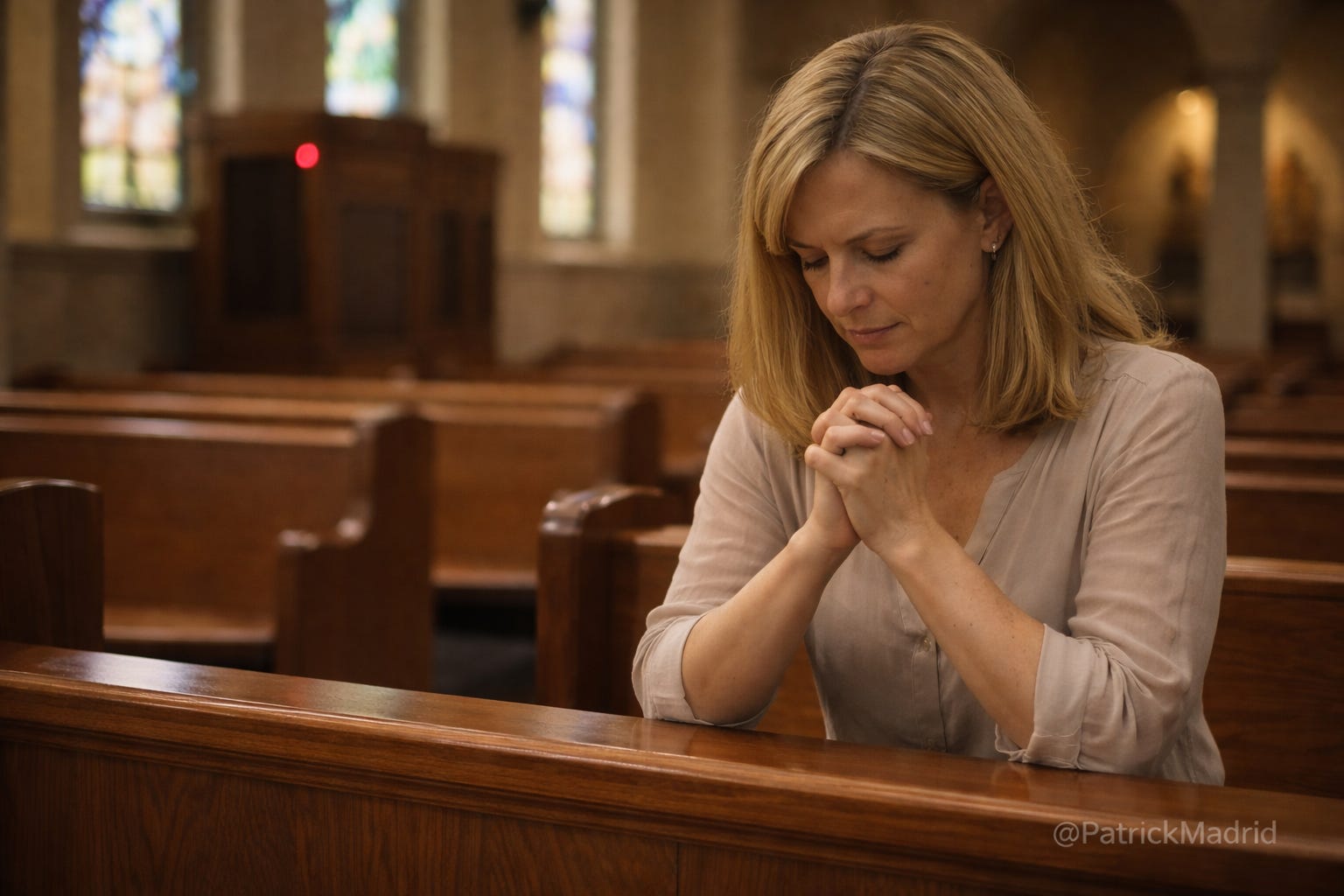
How God works. And how the human heart can sometimes evade His grace out of fear.
She’d been carrying so much pain and hurt inside for so long. I can’t even begin to imagine how difficult that must have been for her, or how deeply it affected her relationships with family and friends, and with God.
The first lesson she taught me is the obvious one: God’s grace is greater than our sins, greater than our failures, greater than the worst moments of our lives. He doesn’t stop waiting. He doesn’t stop calling. He doesn’t stop offering forgiveness, healing, and restoration.
But there was a second lesson, and it took me longer to see it.
Looking back, I realize that none of the rigmarole up front mattered. The Mary arguments. The salvation arguments. All of it was noise.
If I had ignored that interior nudge to be quiet, if I had picked up my Bible and started doing my Mexican hat dance on her arguments, none of the rest would’ve happened. We never would’ve sat down. She never would’ve told her story.
I’m so glad I kept quiet.
Sometimes, as I found out that day, that is the most important thing one can do.
Lesson learned.
When people attack the Faith out of deep pain, apologetics, no matter how thorough, can’t penetrate their defenses. But compassionate listening can, as I discovered, reveal the wound that’s beneath the anger. Only then can real healing begin.
Her story taught me something else, too. “Catholic guilt” is often dismissed as a needless, neurotic shame that “normal” (non-Catholic) people don’t have. But what she carried was genuine guilt from genuine sin, the kind that no amount of attacking the Church could erase.
She’d tried to escape that pain for twenty years by distancing herself from and attacking the Catholic Church, but the burden of pain and guilt followed her. She didn’t need whatever biblical and historical apologetics I originally had wanted to launch at her arguments. What she really needed was what only the Catholic Church can offer: the Lord’s healing grace in sacramental absolution.
In her email, she explained that she’d made a full confession about the abortion, seeking the post-abortion healing Christ offers through reconciliation. This time, the priest—not the one who’d failed her in her crisis—was patient, kind, and wise. He provided the pastoral care she had desperately needed twenty years earlier. She didn’t elaborate on the details, but she didn’t need to. The weight she’d carried for two decades was finally set down.
Her experience illustrates something crucial for anyone who encounters angry ex-Catholics: Apologetics has its place, but pastoral sensitivity must come first. The most eloquent defense of the Faith means nothing if we don’t first meet people in their pain. That’s what Jesus did. When someone lashes out, ask yourself first: Am I hearing an actual objection, or am I hearing the pain of a wounded soul?
Her story represents countless women and men still burdened by the trauma of abortion. For them, the path home to the Catholic Church begins not with Bible verses or apologetics arguments, but with someone willing to listen patiently and then guide them toward the healing Jesus offers in the Sacrament of Confession, which He established for precisely this purpose.
That was the last and only time I ever heard from her.
Copyright © 2026 Patrick Madrid. All rights reserved. All text, images, and other original content are the property of the author.
I hope you enjoy my articles here. If so, please tap the Share button above to post any of them on X or Instagram or to send it to someone who might be interested in it. And if you enjoy thoughtful, friendly, faith-related content, you’ll appreciate my daily program on Relevant Radio. Listen here or get the free Relevant Radio app.

Thank you for sharing this beautiful enlightening story; it nearly brought me to tears however I laughed out loud at “Here, hold this rattlesnake”!
I guess God sends people in trouble to the right person Patrick, may God bless you.