

Truth or Consequences?
What resorting to a “harmless” lie reveals about your character


Deep Dive Podcast Discussion:
RECENTLY ON my radio show, a caller named Todd in Wisconsin raised a question that instantly sharpened the attention of listeners across the country. After forty years of marriage and approaching retirement at sixty-three, Todd discovered that under the current system he would likely have to spend anywhere from $15,000 to $40,000 on medical insurance for his wife until she reaches retirement age.
His proposed solution caught me by surprise.
“Is it sinful,” he asked, “to get a secular divorce to save money on healthcare and protect my assets?”
He and his wife would remain together, remain married in every real sense, and continue their life as a couple. Only the paper trail would change. On the civil record, they would appear divorced so he could avoid paying the insurance costs. He added:
“How is this any different from two people who live together but file separate tax returns? Who exactly would I be sinning against? The insurance company? They’re a giant corporation charging us excessive premiums. Why should I care about saving them money?”
I told Todd that I understood his thinking. Anyone who has ever wrestled with Medicare rules, retirement transitions, or the ever-rising cost of healthcare knows the frustration he feels. The system often penalizes married couples in ways that make little sense. And I readily acknowledged that it would be wonderful if he could avoid shelling out all that money.
But sympathy does not change moral truth. The Catholic tradition has always taught that a man cannot choose what is false in order to secure what is financially helpful.
Scripture speaks directly to the matter. In Malachi, God declares: “For I hate divorce” (Malachi 2:16).
What Todd was contemplating was not an actual divorce in the eyes of God. It would be a staged legal maneuver that would publicly assert something that is not true (i.e., he and his wife had no intention of ceasing to be married). Even a fictional divorce is still an official statement to the state, and to the world, that you are no longer married.
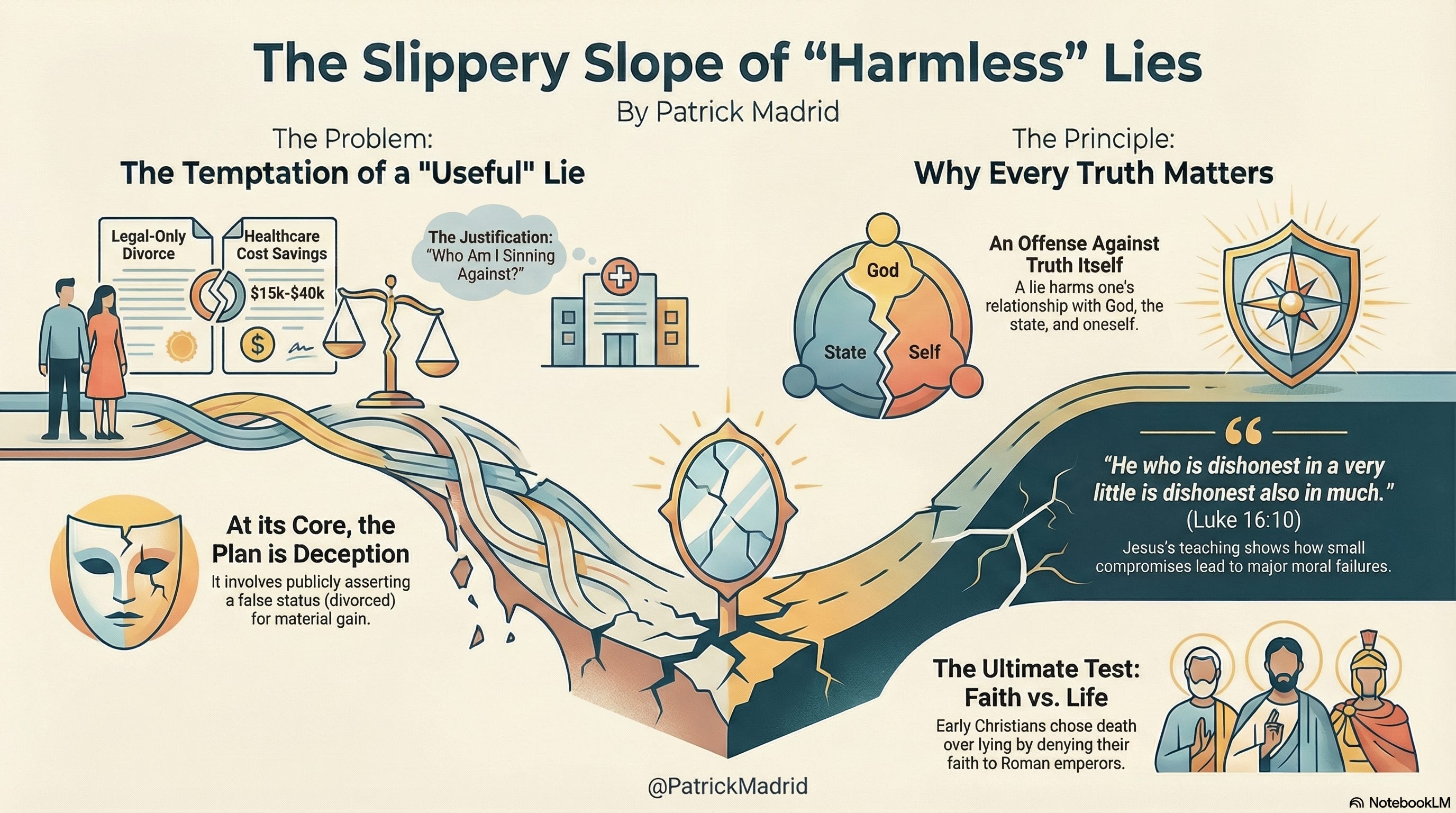
At the heart of this stratagem lies deception. One would be claiming a civil status that does not exist in reality and doing so for material gain. Catholic moral teaching treats truth as sacred because truth reflects God’s own nature. To manipulate the truth for personal advantage violates the conscience before it violates anything else. Lying is a sin. Or as God put it it:
“Thou shalt not bear false witness.”
To help Todd evaluate the question more clearly, I asked him to imagine a sliding scale. At one end sits a lie that seems harmless. At the other end sit the heroic men and women throughout Christian history who refused to deny Christ—even symbolically—under threat of torture or death.
Every compromise with the truth moves a person along that scale.
Todd repeated his central question: “Who would we be lying to?”
First, to God.
Second, to the government.
Third, to yourselves.
The kind of falsehood he was contemplating would be an offense against the truth itself. Jesus said “the truth will set you free.”
To make my reason for saying this a bit clearer, I offered him a hypothetical:
Suppose the government imposed a $10,000 annual tax on every Christian. Would he deny being a follower of Jesus to avoid paying it? Would he check a box claiming to be non-Christian while telling himself internally that God knows the truth?
If so, he would be imitating Peter in the courtyard: “I do not know the man!” (Matthew 26:72).
This may seem far-fetched to American ears, but in modern Germany, for example, citizens must register their religious affiliation for tax purposes under the government-administered Kirchensteuer (Church Tax) system. It is a real mechanism for distributing tax revenue to Catholic and Lutheran bodies. The lesson is simple: governments often create financial structures tied directly to religious identity.
Or what about a Christian living in a Muslim-controlled country who’s tempted to deny Jesus and claim to be Muslim to avoid paying the jizya tax imposed on non-Muslims under sharia law?
I reminded Todd and my audience of the early Christians who faced far darker choices.
Policy of Truth
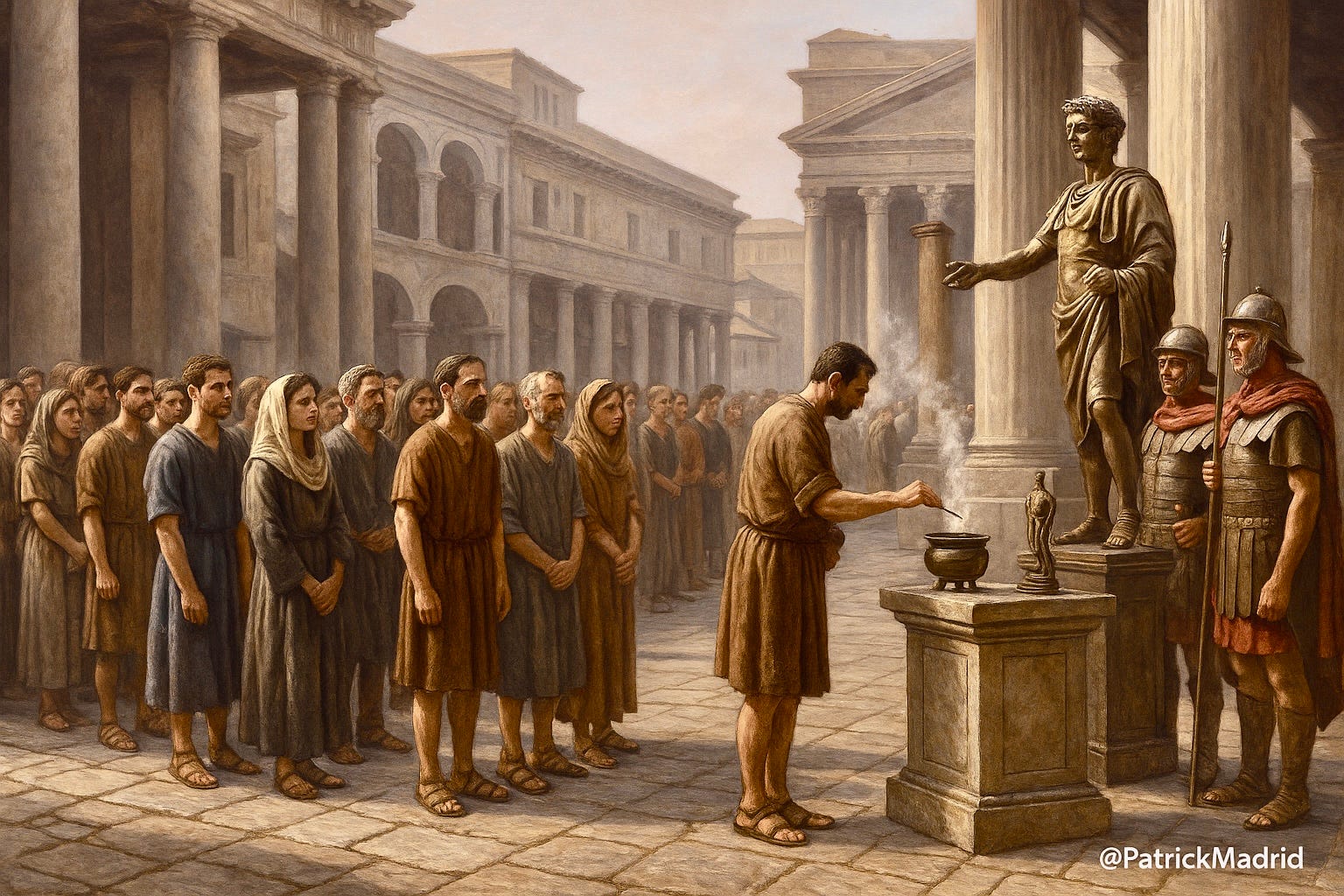
During the reigns of Roman emperors such as Trajan (who lived from 53 to 117), Decius (who lived from about 201 to 251), Valerian (who lived from about 200 to 260), and finally Diocletian (who lived from 244 to 311), various imperial edicts required inhabitants of the Empire—especially in regions where fierce and bloody persecutions erupted—to offer public acts of loyalty to Caesar and to the Roman gods.
These acts often included swearing fealty to Caesar as divine and offering incense before his image. Compliance with these decrees demanded an explicit denial of faith in Jesus Christ. Countless Christians refused. They chose agonizing, torturous deaths rather than deny the Lord they loved. Their courage embodies St. Paul’s warning to Timothy:
“If we endure, we shall also reign with him; if we deny him, he also will deny us; if we are faithless, he remains faithful, for he cannot deny himself” (2 Timothy 2:12–13).
Some faced with such a terrible choice (renounce Christ and live or proclaim their faith in Christ and be killed) certainly tried to rationalize: “I don’t truly believe Caesar is divine. I will only look as if I do.” But the act itself was the lie.”
And Jesus had already warned them: “For whoever would save his life will lose it, and whoever loses his life for my sake will find it” (Matthew 16:25).
Little Lies
While Todd’s legal-fiction “divorce” dilemma was not life-or-death, it followed the same pattern: a proposal to state publicly something that is false to avoid a financial burden. Once a man convinces himself that lying is acceptable for a manageable difficulty, he slowly trains his conscience to accept falsehood in far weightier moments.
This is why the Catholic tradition speaks so strongly against lying.
The Catechism teaches:
“A lie consists in speaking a falsehood with the intention of deceiving” (CCC 2482).“By injuring a man’s relation to truth and to his neighbor, a lie offends against the fundamental relation of man and of his word to the Lord” (CCC 2483).
St. Thomas Aquinas taught that lying contradicts the very purpose of speech: “A lie is sinful in itself, since it is against the virtue of truth” (Summa Theologiae II-II, q. 110, a. 3). While not all lies are equally grave, all are morally disordered because they betray the debitum veritatis—the dept of telling the truth due to God and neighbor.
St. Augustine, in his treatise On Lying, insisted that no motive, however noble, can make a lie righteous.
And St. Paul crushed the idea completely:
“And why not do evil that good may come?” (Romans 3:8). His answer is blunt: the condemnation of such reasoning “is just.”
Jesus taught this principle with a simple but piercing reminder of what lying can lead to:
“He who is faithful in a very little is faithful also in much, and he who is dishonest in a very little is dishonest also in much” (Luke 16:10).

Would I Lie to You?
And this is where a personal experience drove the point home for me. After Todd’s call ended and we came back from the break, I shared this personal story:
Before joining Relevant Radio, I spent years working solo as an author and public speaker, hustling from speaking event to speaking event to keep our large family afloat. Money was always tight. So when one of our oldest daughters announced her wedding, Nancy and I poured every spare cent into making it beautiful. By the time the big day approached, we were pretty much drained dry of discretionary funds.
The afternoon before the wedding, I played a round of golf with my sons and a few male relatives. I’m no golfer, but I love being outdoors with my boys. We rented carts, lunched on hot dogs and beer, and enjoyed the day.
Until a moment arrived that tested me.
A teenager in our group, well-meaning and eager, took the wheel of a cart even though drivers had to be eighteen. Just as we were heading into the golf cart lot, he misjudged the turn and crashed straight into a tree. The cart’s front was smashed in and the axle bent. Oh joy. I knew I was looking at a steep repair bill that I could not afford.
As we pushed the wreck back to the clubhouse, I felt the temptation:
Say nothing. Walk away. Let the course figure it out tomorrow.
A single unspoken truth would have spared me a financial blow at the worst possible moment.
But integrity is not negotiable. So I walked into the clubhouse, asked for the manager and explained exactly what happened, braced for the fallout.
The manager listened, then surprised me with a smile. “Sir, you could have just walked away,” he said. “Most people do. And I really, really appreciate that you did the right thing and told me what happened. Thanks for being honest.”
Insurance would cover everything, he said. No deductible. No penalty. No disaster. No money out of my pocket!
The cost of being honest turned out to be zero. And the reward was a clear conscience.
And that episode taught me something that bears directly on Todd’s dilemma: The moment you let yourself believe that “little lies” are harmless, you begin shaping a character that will not stand firm when the larger tests come.
Truth Hurts
When our conversation ended, Todd told me the discussion helped him see the issue more clearly. We went to a break, so I never learned what he ultimately decided. But the deeper question remains for all of us:
How far are you willing to go in bending the truth to avoid a hardship? Remember:
Little lies rarely stay little.
Telling little lies conditions your soul to tell bigger lies.
And every time you bend the truth, you’re training your heart for the day when staying faithful will cost far more than mere money. Which is exactly what Jesus meant when he said that if you’re faithful in little things, you’ll be faithful in big things—and if you’re unfaithful in little things, you’ll eventually be unfaithful in the big ones too.
Copyright © 2025 Patrick Madrid. All rights reserved. All text, images, and other original content are the property of the author.
I hope you enjoyed this article. If so, please tap the Share button above to post this or any of my other free articles to your X, Facebook, or Instagram pages or to send it to someone who might be interested in it. And if you enjoy thoughtful, friendly, faith related content, you’ll appreciate my daily program on Relevant Radio. Listen here or get the free Relevant Radio app.

I remember this call and I remember your clear, sound logic and I agree with you. But, you have probably answered this question many, many times. It’s 1943 Germany and the Gestapo gets a tip you are hiding Jews in your home. Do you lie to protect the Jews or not? I know it’s an extreme example but deception is still there and like God said, “do not bear false witness”. Is there a moral exemption or exception to protect life?
Or Todd’s wife could be a greeter at Walmart til she reaches retirement age, get health insurance as an employment benefit and they’d also be financially even better off from the extra income.