

Waking Wilfred Parker
A Friendship I Never Expected—and Never Forgot

Deep Dive Podcast
Audio segment produced with AI narration summarizing Patrick Madrid’s written content.
WHEN I WAS 19 years old, I never could have imagined that I would form a true friendship with a woman in her mid-80s. But it happened in the most astonishing and unexpected way and still evokes a happy memory in me all these years later.
Her name was Maude Parker, a sweet, gracious, petite woman who, when I first met her, seemed ancient to me. The only reason we even met in the first place was because her husband, Wilfred, was a patient in the convalescent hospital where I worked for a time as an orderly.
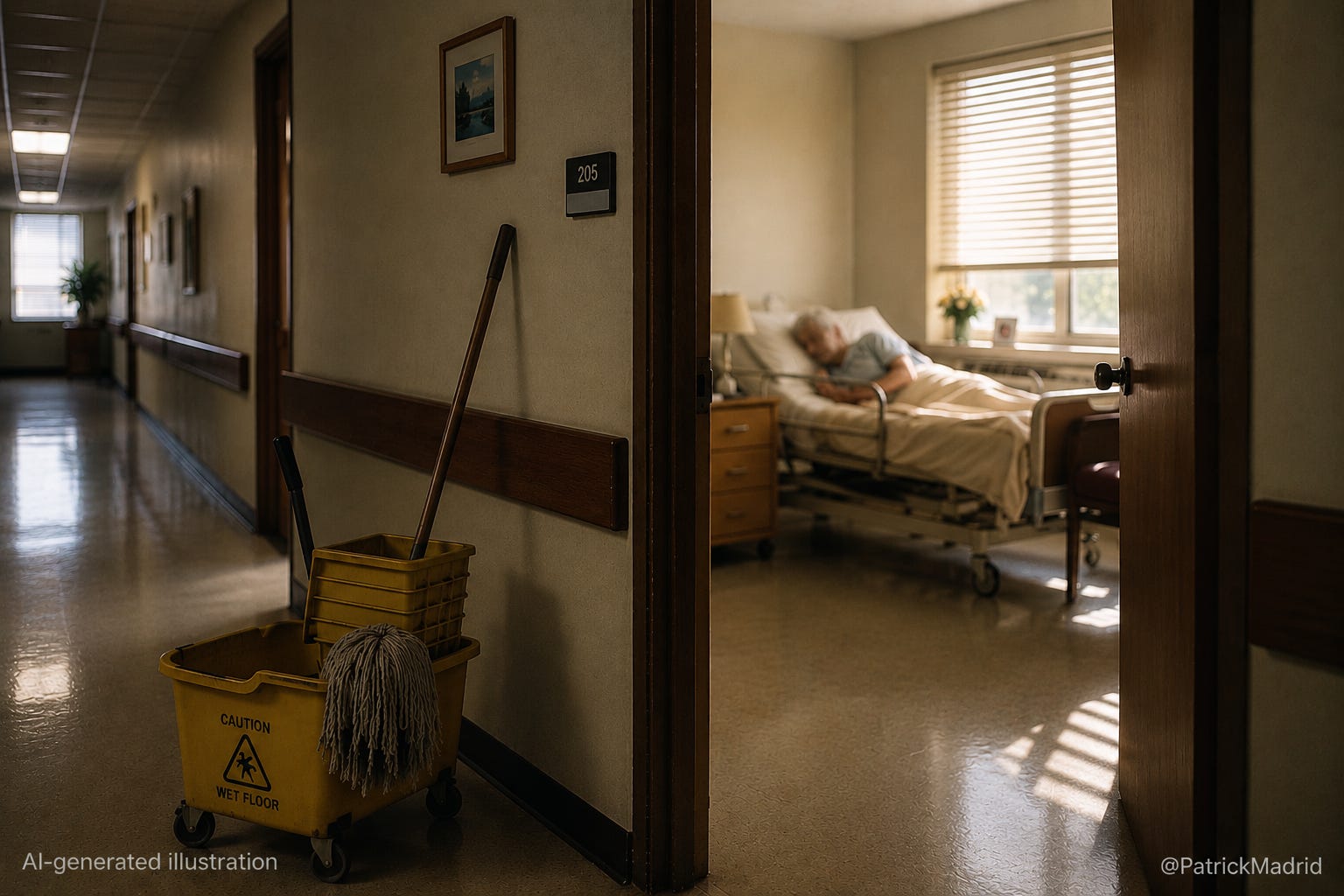
The wing I was assigned to had 10 private rooms, five on each side of the hall. As an orderly, I occupied the very lowest rung of the ladder, with nurses’ aides above that, and though there was a physician who visited patients on a regular basis, it was the skilled nurses (RNs and LVNs) who ran the show.
A word about the duties of an orderly in that facility: Being the lowest-level position, it carried with it responsibility for the most menial jobs. This included everything from cleaning up vomit, changing bedpans, emptying urinary catheter bags, changing soiled sheets (and “soiled” is a true euphemism here), lots of mopping, moving patients through the halls in their wheelchairs, brushing people’s teeth or, more commonly, brushing their dentures and making sure they were properly submerged in a glass of water with Polident to clean them, shaving the men, washing and combing patients’ hair, and more.
Overall, you could say my job was to help the patients stay clean, dry, and comfortable, clean up any and all messes, and make sure their rooms were tidy.
Oh, and I also had to change colostomy bags.
I remember early in my orientation, when I first started, an RN was showing me the ropes of what I was expected to do, and she mentioned colostomy bags. I had no idea what that was. I had never even heard the term before, much less did I know about the procedure that resulted in a patient wearing one. If you are unaware of what it is, as I was then, just look it up. That’s all I’m going to say.
The nurse showed me how to change them, and it henceforth became one of my regular tasks.
Wilfred, Maude’s husband, was also in his mid-80s, seeming just as ancient as she, except that he was more or less comatose. He never woke up, never spoke, or showed any sign of being aware of his surroundings. And he was very restless. I recall thinking that it was almost as if he were trying to ride a bicycle while lying on his side.
For Wilfred’s safety, the nurse in charge deemed it necessary for him to wear cloth wrist and ankle restraints, loose but still firmly attached to the metal rails of his hospital bed. This allowed him some range of movement but prevented him from falling out of the bed. Other comatose patients I served were entirely motionless, and I had to gently reposition them every few hours to prevent bedsores.
I meticulously logged these small but important duties for each patient on a chart which I was responsible for turning in to the head nurse on duty at the end of my shift.
Unlike the other patients, Wilfred moved on his own constantly and restlessly. I wondered often what he might have been dreaming about.
Changing Wilfred’s colostomy bag was part of my job. At first, I was grossed out by the very thought of it, but after I overcame my initial revulsion, I did what needed to be done, though never without some squeamishness.
Over the course of my time working there, I saw a lot of things. I saw a couple of people die.
Once, I was summoned “Stat!” by the nurse on duty to assist with transferring a dying woman from her bed onto a gurney.
Supporting her under her arms as I stood at her head, another orderly held her legs as we lifted her gently off the bed. But before we could move her to the gurney, less than a foot away, she literally expired in my arms. I watched her take her last breath, and although I can’t say I “saw” anything paranormal, I had the distinct, almost palpable, sensation of her soul passing out of her body as she died in my arms.
That was a profoundly powerful moment for me, as I had never seen anybody die before.
Not long before that, another patient on my wing had died alone in the early morning hours before I started my shift. When I clocked in, the nurse on duty informed me that my first job that day would be to clean his body and prepare it for the mortuary to pick up. I had no idea what to do! I had never seen a corpse before. But there he was, several hours dead, waiting for me.
To my surprise, I wasn’t squeamish or afraid. Instead, I felt a kind of solemnity as I cleaned his face and hands with a warm, wet washcloth.
The nurse had given me only minimal instructions, and I don’t remember much now beyond her explaining that, upon death, all the muscles of the body relax and grow slack and that I should expect there to be a bowel movement that would need to be cleaned up before the morticians arrived. She was right.
That was the first time I came face-to-face with death. It left a lasting impression on me. I’ve thought about it many times since then, knowing that someday somebody will tend to my body after I have died.
I was called upon to be present when nurses catheterized patients, typically men. Another reality I had never even heard of before seeing it.
Giving showers was also part of the job. These unpleasant close encounters with the ravages of old age and the various debilitations and humiliations they visit upon men and women who were once young, healthy, and beautiful, taught me a lot about life when I was only 19.
There were other profoundly important and difficult lessons about old age, suffering, loneliness, and loss that I never would have learned otherwise.
Some patients were recovering from catastrophic strokes. Early on, I didn’t really understand what a stroke was. But as part of my training, the nurses explained what these physical disasters do to the human body and what my role would be in assisting stroke patients under my care.
Aphasia was one common effect I learned about. The patient is lucid and wants to communicate but can’t, the only sounds that come forth are often stammered syllables. In the case of one aphasic man on my wing who was recovering from a massive stroke, nothing but “no, no, no” came out, when he probably meant “yes” or anything else he might have been trying to express.
I still remember that helpless, hopeless look in his eyes as he struggled to communicate with me.
“No, no, no” was all he could say whenever I stepped into his room and asked if I could help with anything. “No, no, no.” At first, I thought he didn’t like me for some reason. I soon discovered, though, that this was the only word he could say to anybody.
One particular patient I remember quite well was in his early 50s. I’ll call him Richard. Felled by a stroke in the prime of his life, his successful career suddenly cut short, Richard’s left side was withered. His face was contorted in a frozen mask that dragged the left side of his mouth downward in a snarl and the fingers of his now useless hand curled mercilessly into a claw.
His wife, he told me more than once, was beautiful. The love of his life. But she hardly ever visited.
Over the many hours I spent in Richard’s room, he gradually opened up and shared with me, laboriously because of the effects of his stroke, how angry and frustrated he was. He was convinced that his beautiful wife was “stepping out” and seeing other men.
He spoke bitterly of the agony he felt at being “trapped” (his word) in the facility, immobilized by his stroke while his lovely wife carried on with her life.
Though she rarely came to visit him (I only ever saw her once), when she did, he said she was always made up and well dressed, which led him to assume the worst. The Kenny Rogers song “Ruby, Don’t Take Your Love to Town” suddenly took on a new meaning for me, forever changing the way I’ve heard it ever since.
Once, she happened to visit him while I was working in his room one afternoon. She was indeed attractive and dressed as if she were going out. I couldn’t help but wonder whether Richard’s suspicion was true; that out in the parking lot some guy might have been waiting for her in the car.
I’ll never know.
But I’ve never forgotten the anguish Richard expressed about the situation. I was surprised that he would confide something so intimate to me, a mere orderly. Looking back, I can see that he did so because he was terribly lonely and felt abandoned by his wife. Maybe I was the only person he felt he could talk to.
I learned other important lessons about the elderly, aging, death, and dying. Lessons I’m grateful for. I feel as though I have, as a result, an understanding of people going through those situations that I might well never have had were it not for my time working there.
Even though Wilfred remained unconscious, I think it was because he was always moving so restlessly in his bed, endlessly pedaling that imaginary bike, that I took to talking with him. It was always a strictly one-sided conversation.
While working in his room, shaving him, clipping his finger nails, and tidying up his room, I’d talk to him. It didn’t really register that he might have actually heard anything I said. I assumed he was so out of it that I was basically just talking to myself. Even so, I made an effort to talk to him, addressing him by name:
“Good morning, Wilfred! How are you doing today?”
“I’m just going to be cleaning in here for a while. Let me know if you need anything.”
“Hey, have a good one, Wilfred. I’m leaving now. See you tomorrow.”
That kind of thing. I didn’t really give it any thought.
That is, until I showed up at his room one morning and was happily surprised to see Maude there, beaming, standing by his bed. I had met her any number of times before during her frequent visits. She was always polite and friendly, but I sensed she wanted and needed time alone with her comatose husband. Who knows what words she spoke to him when they were alone?
Usually, when Maude arrived, smiling as always, I would quickly finish my duties and leave so she could have some privacy. But that particular day, when I entered the room, she was positively glowing, and it was immediately apparent why: Wilfred was sitting up in bed! His eyes were open! He was awake! He was able to communicate!
In all the time I had worked in his room, I had never seen him conscious and lucid, so I was just as astonished and happy as she was and couldn’t help grinning when she motioned for me to come closer to the bed.
“My Wilfred is awake!” she exclaimed, overcome with delight. Her right arm was draped around his shoulders, her left hand clasped lovingly in his. He was smiling, and she was beaming. Her sheer joy at having him back was palpable and beautiful to behold.
All I could think as I stepped toward them was, “Wow! What a wonderful surprise!”
I said “hello” to Wilfred as though we were meeting for the first time, even though I had spent many hours in his presence while he was comatose. But was he really comatose? That’s when I began to wonder, because Maude told me he had said he knew I had been there helping him. Apparently, my habit of filling the time by talking to him while I worked, never imagining he could hear a word I was saying, had actually gotten through.
The nurses and the doctor also seemed surprised at this wonderful improvement in his condition. This kind of return to lucidity doesn’t happen often, especially for somebody of his advanced age, whose health was precarious. It felt good to finally know him a little after all the time I had spent watching him restlessly, endlessly “ride an imaginary bike” while lying in bed, seemingly unaware of his surroundings.
Not long after, Maude bid me goodbye one day when I arrived to tend to Wilfred. She had been visiting him every day, and his improvement had been so remarkable that he was being discharged to go home. I was sorry to have to say goodbye to both of them. I would have liked to continue seeing them, but, as Frank Sinatra put it, “That’s life.”
The day Maude checked Wilfred out of the facility and brought him home was bittersweet for me. She wrote down her address and phone number and asked me to keep in touch. I gave her my number as well. I figured our interesting relationship would end there, but it didn’t.
Wilfred’s health was still pretty bad, and he didn’t have long to live. Several weeks later, he passed away. But the story didn’t end there. His passing marked the beginning of my friendship with Maude.
She stopped by while I was working to let me know that Wilfred had passed away and to invite me to attend his wake and funeral. I was deeply touched, especially since I was just a 19-year-old kid and she was old enough to be my great-grandmother. Yet she had taken a sincere interest in me and seemed to appreciate that I, who until recently had been little more than a stranger, was genuinely saddened by her husband’s death. It meant a lot to me that she would invite me to his funeral.
What really surprised me, though, was that Maude invited me to her home for dinner, just the two of us. It was beautiful and, even then, long before I had really gained any sense of perspective in life, very meaningful to me. She invited me to dinner so she could show me their wedding pictures and so many other pictures of their life they had shared in the early 20th century, long before I was born.
I discovered that Wilfred was born in April 1893, in what was then the New Mexico Territory, nearly 20 years before it attained statehood. He died on July 6, 1980, at the age of 87.
Maude’s story was even more fascinating. Born in Australia in June of 1895, her saga of eventually immigrating to the United States as a young woman, meeting and marrying Wilfred, and everything that followed was, for me, a kid from suburban Southern California, like an enchanted tale from a forgotten time in an exotic, long-ago place.
The picture album she shared with me was amazing. Seeing the two of them young and beautiful, so full of life, while knowing what came afterward, moved me in a way I can’t fully describe. I saw them as they had been long before they had grown old, decades before Wilfred’s decline into poor health, and before their lives intersected with my own during the time I spent caring for him in the convalescent facility. It made a deep impression, one that remains with me even now.
If memory serves, Maude and Wilfred never had any children, but their long life together, judging from the many smiling pictures of them in her photo album, I could see that they had, nonetheless, a happy and full married life together.
The deepest impression, though, was that Maude, some 65 years older than I, considered me her friend. That was the only time I ever visited her home, and I’m both sad and sorry to say that I never went back to visit her, though she invited me to. I did drive by her house once and thought about stopping in to say hello, but I must have been busy and kept driving. I have regretted that ever since.
How I wish I could go back in time and thank her for her kindness and thoughtfulness in sharing with me, through her happy stories and the photographs in her album, glimpses of their long life together.
All these years later, as I reflect on that brief time I spent as an orderly in that convalescent facility, I think about some important lessons I never would have learned had I not had the opportunity to work there. Most of the elderly patients I cared for never regained their health as Wilfred did, or at least I wasn’t there long enough to see it happen.
I marveled at Wilfred’s amazing and unexpected recovery, though it was only temporary, and was grateful to have played a small role in his waking up. Maude told me she thought he would never wake up and would just fade away until he died. The doctors had told her to prepare for that because, they said, he would likely never regain consciousness.
No doubt others in that facility showed him kindness and compassion, but Maude told me several times, with obvious emotion, that she believed my visits and my efforts to talk with him had made a difference. I hope so.
She said Wilfred had told her that too. I’ll never know whether my actions played any part in it, but I hope they did. I was truly glad to have been able to get to know him, even if only briefly, when he woke up. As I look back, it would have been sad if I had only ever known him while he was asleep.
Only recently did it occur to me to do some Internet checking to see how accurate my memories were. That’s when I discovered the rest of the story. Maude died at 97 on Christmas Day, 1992, over a dozen years after I last saw her.
She was buried next to Wilfred in a modest cemetery in a nearby town. Her kind invitation to “come back and visit” went unfulfilled, I’m sorry to say. I really regret that now.
She lived not far from where Nancy and I were raising our children. If I had only known! If only I had bothered to stay in touch with her! How I wish now that I had. I would have loved to have introduced her to our growing family. Having no children of her own, Maude would no doubt have loved that and would have loved them.
I’m grateful that Maude thought enough of me to invite me to dinner after Wilfred passed away. That simple act of kindness has stayed with me ever since. I wish I could thank her once again. I pray for them and hope I’ll see them someday in heaven.
“Hello, Wilfred! Hello, Maude! Do you remember me? It’s so good to see you again!”
In the meantime, I’m grateful most of all for the unexpected and much-needed gift of learning the importance of making an effort to be present to people (a lesson I am continually relearning). It taught me the importance of speaking to people even when they don’t appear to be listening because, sometimes, they are.
Copyright © 2026 Patrick Madrid. All rights reserved. All text, images, and other original content are the property of the author.
I hope you enjoy my articles here. If so, please tap the Share button above to post any of them on X or Instagram or to send it to someone who might be interested in it. Restacking this article will also help it reach a wider audience. Thank you!
And if you enjoy thoughtful, friendly, faith related content, you’ll appreciate my daily program on Relevant Radio. Listen here or get the free Relevant Radio app.

So touching, sweet, and miraculous. My mother, who had and raised eight children (but always wanted 12!) was the first person to ever tell me that at the beginning of our lives we are helpless and at the end of our lives we are helpless, which, when she told me, was something I had never thought about before. It also reminds me of Our Lord's words to Peter "... when you were young, you dressed yourself... when you are older... others will ... take you where you do not want to go..." Such a wonderful part that nature plays in the plan of God, especially for those who attain old age, that the humiliation and suffering that often comes with getting older does so much to atone for the sins committed in the prime of our lives. We likely would have never chosen any of these necessary remedies for our selves, but the Good Lord, in his wise generosity, nevertheless visits them automatically on so many.
Thank you for your article. I’m presently in a retreat titled Consoling the Heart of Jesus by Fr. Gaitley. Your compassion for this man is consoling the heart of Jesus. Your talking to him and caring for him was Jesus caring for him, letting him know he was not alone. Before my father died, the Lord spoke to my heart to go to him and make a confession for him. I did. My sisters and mom were there and we told him we forgive him for his treatment of us and asked him to forgive us. My mom then said an act of contrition in his name. Shortly after he died I had a dream of him. In the dream he was encouraging me and interested in what I said, something he didn’t do while alive. That was 26 years ago and I remember the dream as if I had it last night. I believe he was telling me he heard me and was thanking me. Thank you again.