

Why Do Catholics Have Crucifixes?
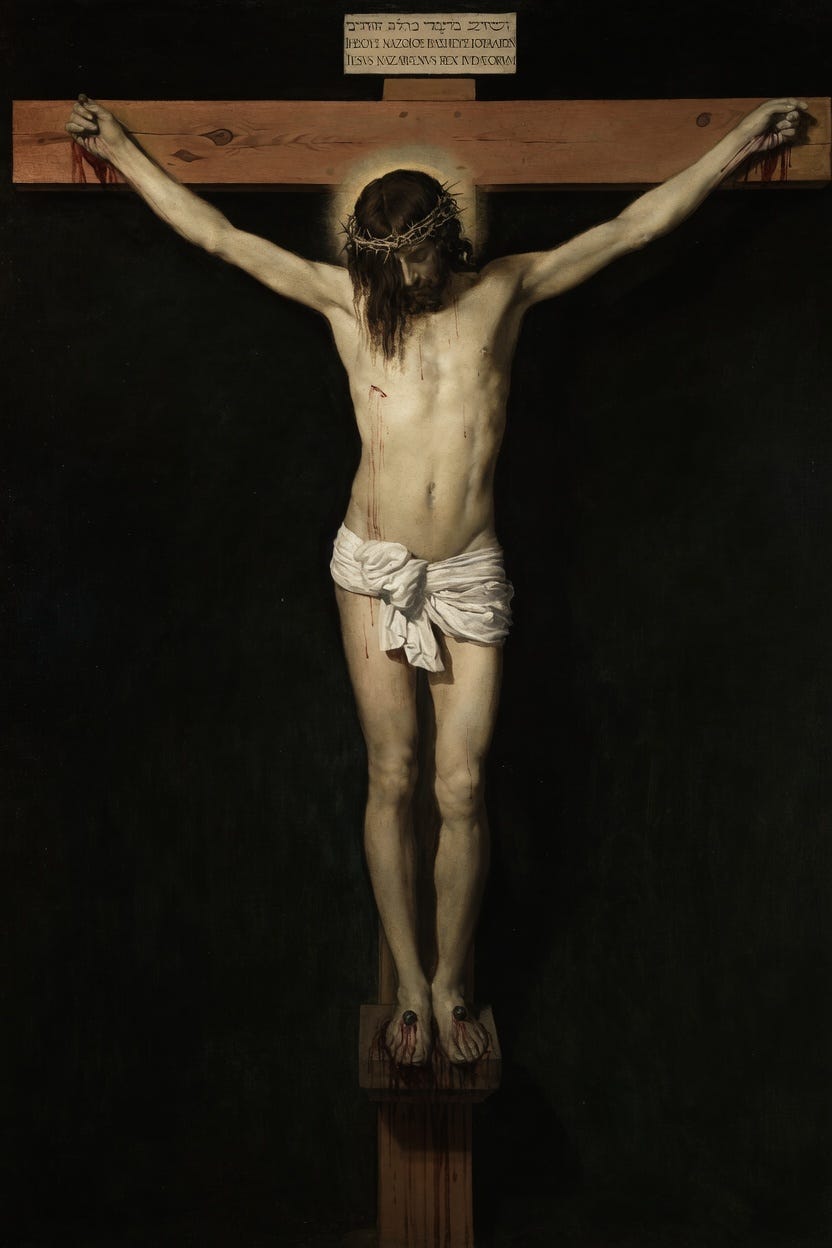
The crucifix doesn’t deny the Resurrection. It’s the reason the Resurrection matters.

Deep Dive Podcast
Audio segment produced with AI narration summarizing Patrick Madrid’s written content.
MANY NON-CATHOLICS have an aversion to crucifixes. While they have no problem with an “empty cross,” some Christians, particularly many Protestants, object to the crucifix because it depicts Christ dying on the cross.
“Christ isn’t on the cross anymore,” they say. “He’s reigning gloriously in heaven. So why emphasize His death?”
This is a reasonable question, and it deserves a reasonable answer.
Let’s start by recognizing that Catholics emphasize both the Crucifixion and the Resurrection, not minimizing or downplaying the importance of either.
In our manger scenes, stained glass windows, and statues, we also depict the Lord as a baby in the manger, as a toddler in His mother’s arms, and as a young man teaching the rabbis in the temple.
Each of these stages of the Lord’s life is worthy of depiction. But the focal point and purpose of Christ’s Incarnation and ministry was His death on the cross. As He Himself said, “For this I was born, and for this I have come into the world, to bear witness to the truth” (John 18:37).
The late, great Archbishop Fulton Sheen summarized memorably the reason for using a crucifix instead of an empty cross:
“Keep your eyes on the crucifix, for Jesus without the cross is a man without a mission, and the cross without Jesus is a burden without a reliever.”
Isn’t it true that when you see an empty cross, your mind automatically “sees” Christ there? After all, we recognize that the cross only has meaning because Christ died on it for our salvation. Catholics use crucifixes to avoid what Saint Paul warned about: allowing the cross to be “emptied of its power” (1 Corinthians 1:17).
In the first few centuries of Christianity, neither the empty cross nor the crucifix was used by believers as a symbol of Jesus Christ.
The “fish” symbol was the more primitive symbol. It comes from the first letter of each word in the phrase “Jesus Christ Son of God Savior” (Ἰησοῦς Χριστός Θεοῦ Υἱός Σωτήρ, Iēsous Christos Theou Huios Sōtēr). These letters handily spell out the acrostic ICHTHYS, the Greek word for “fish” (ἰχθύς).
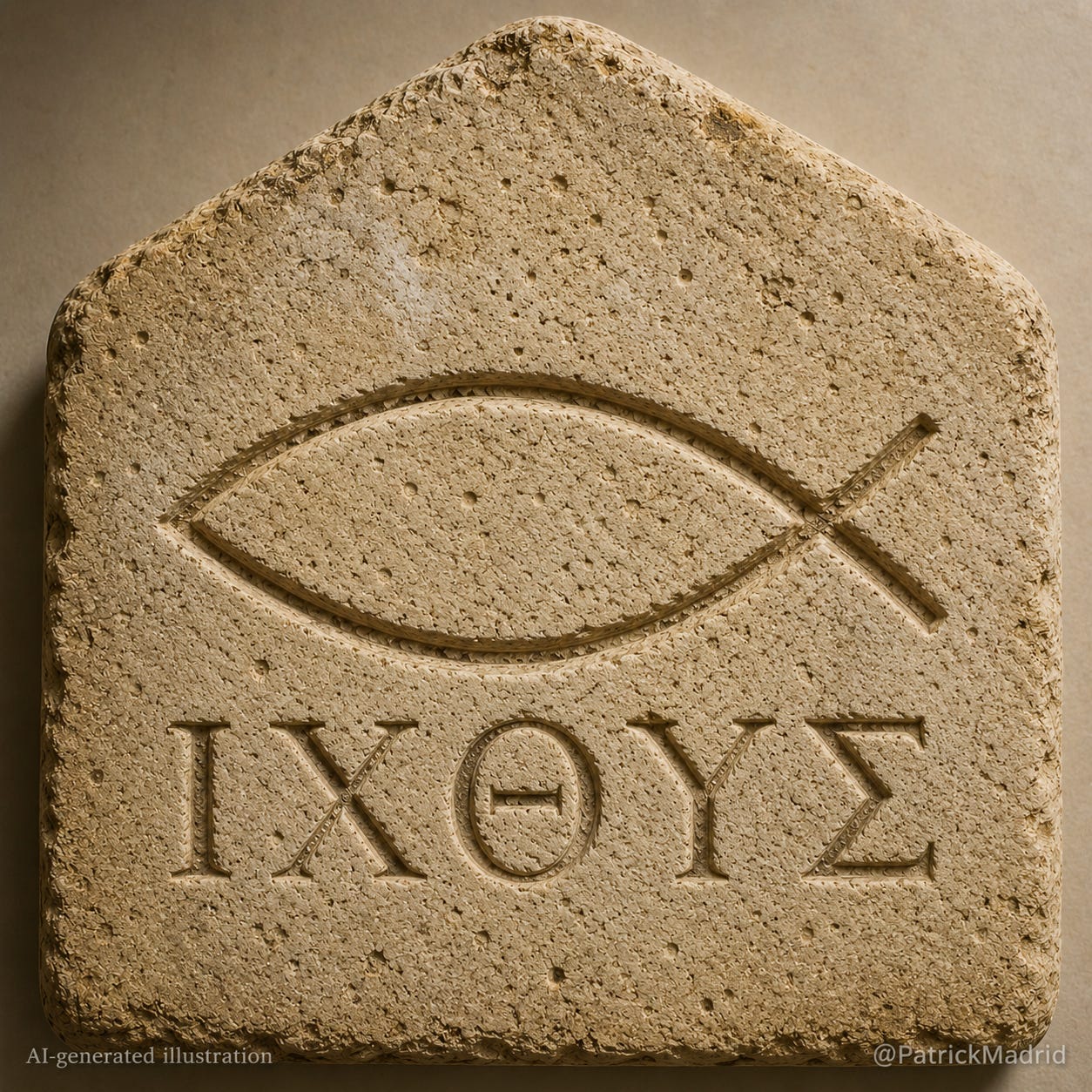
Tertullian wrote about this, saying:
“But we, little fishes, after the example of our ΙΧΘΥΣ Jesus Christ, are born in water, nor have we safety in any other way than by permanently abiding in water; so that most monstrous creature, who had no right to teach even sound doctrine, knew full well how to kill the little fishes, by taking them away from the water.”
Tertullian, On Baptism 1 (c. A.D. 198).
St. Augustine said:
“[T]he initial letters of these five Greek words, Iēsous Christos Theou Huios Sōtēr, which mean, ‘Jesus Christ the Son of God, the Savior,’ . . . make the word ichthys, that is, ‘fish,’ in which word Christ is mystically understood . . .”
Saint Augustine, The City of God XVIII. 23 (A.D. 413-426).
The fish symbol remained a powerful and easy-to-understand symbol of Jesus ever since those early days of the Church, making something of a comeback, especially among Evangelical Protestants in the 1970s, and is widely recognizable as a symbol for Jesus and Christianity as such.
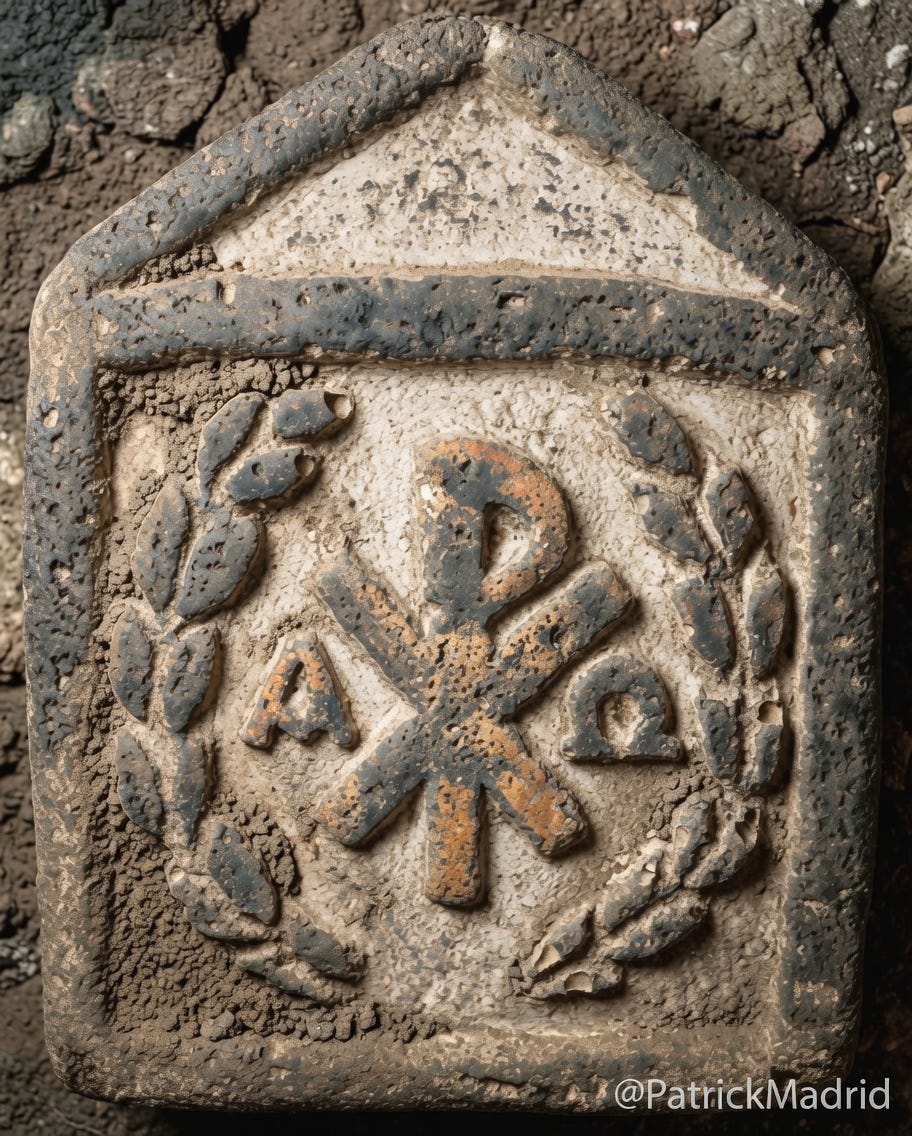
But after the first few centuries removed from the age of the Apostles, the cross began to grow in prominence as a similar and more pointedly specific reference symbol for Jesus and, specifically, the supreme act of His love by dying on the cross for our salvation. The Ichthys symbol never went away, but it was soon overwhelmingly eclipsed by the plain cross and variations such as the Chi-Rho cross.1
The Catholic Encyclopedia points out that the cross was “an instrument of punishment in the ancient world” (The Catholic Encyclopedia, “Archæology of the Cross and Crucifix,” vol. 4, page 518 [New York: Robert Appleton Company, 1908]).
“It was at Rome, however, that from early republican times the cross was most frequently used as an instrument of punishment, and amid circumstances of great severity and even cruelty. It was particularly the punishment for slaves found guilty of any serious crime. Hence, . . . Cicero calls it simply ‘servile supplicium,’ the punishment of slaves.”
(The Catholic Encyclopedia, “Archæology of the Cross and Crucifix,” page 518.)
This horrible manner of death the Lord endured on the cross was understandably not something the earliest Christians chose to make the very emblem of their faith in Him, but after one or two generations removed from the apostolic era, the general Christian sensitivity had abated, and by the end of the 2nd century, the cross had become an increasingly prominent and widely recognized symbol in early Church liturgy, piety, and art.
By the early 200s, St. Clement of Alexandria (Stromata VI) “speaks of the Cross as tou Kyriakou semeiou typon, i.e. [Latin:] signum Christi, ‘the symbol of the Lord's sign’” (The Catholic Encyclopedia, “Archæology of the Cross and Crucifix,” p. 518). 2
Around that same time, Tertullian explains that making the sign of the cross was so ubiquitous in the early Church that “We Christians wear out our foreheads with the sign of the cross” (De Corona 3).3
Historically, icons of Christ crucified and three-dimensional representations (crucifixes) began to appear, here and there, by the late 100s and early 200s, but did not become commonplace until between the 400s to the 600s.
These icons and images served as a powerful symbol that preached the gospel, especially to those who were illiterate (a significant majority of people in antiquity and into the middle ages).
Christ’s supreme act was to die on the cross as atonement for our sins. His Resurrection was proof that what He did on the cross had perfectly fulfilled its atoning and saving purpose.
He conquered death, and it demonstrated beyond any doubt that He was who He claimed to be: God. The Crucifixion was the act that changed history. The Resurrection demonstrated the efficacy of that act.
By His death on the cross, Christ conquered sin and death, redeemed the world, opened the way of salvation for all who would receive it, and reconciled His people with the Father (Ephesians 2:13-18; Colossians 1:19-20). That is why the crucifix is such a potent reminder for us of what He did on our behalf that dark afternoon on Calvary.
Jesus told His disciples, “If any man would come after me, let him deny himself and take up his cross and follow me” (Matthew 16:24; see Matthew 10:38).
True, resurrection and glory await all those who follow Christ faithfully, but we will only arrive there by walking the way of the cross.
Saint Paul emphasized the Crucifixion, saying:
“When I came to you, brethren, I did not come proclaiming to you the testimony of God in lofty words or wisdom. For I decided to know nothing among you except Jesus Christ and him crucified” (1 Corinthians 2:1-2, emphasis added).
And in 1 Corinthians 1:18-24 Saint Paul said:
“For the word of the cross is folly to those who are perishing, but to us who are being saved it is the power of God.... [I]t pleased God through the folly of what we preach to save those who believe. For Jews demand signs and Greeks seek wisdom, but we preach Christ crucified, a stumbling block to Jews and folly to Gentiles, but to those who are called, both Jews and Greeks, Christ the power of God and the wisdom of God” (emphasis added).
In Galatians 6:14 he proclaimed:
“But far be it from me to glory except in the cross of our Lord Jesus Christ, by which the world has been crucified to me, and I to the world.”
And lest anyone imagine that the early Christians did not focus their minds on Christ’s death on the cross, consider what Saint Paul says in 1 Corinthians 11:26, where he again emphasizes the Crucifixion:
“For as often as you eat this bread and drink this cup, you proclaim the Lord’s death until he comes.”
Recall the scene of the Crucifixion: Some in the crowd present at Calvary shouted at Christ as He was dying, “Come down off your cross!” (see Matthew 27:40; Mark 15:30).
How strange and sad that those same words echo today in the objections to the crucifix as a reminder of Christ’s perfect sacrifice.
All Christians should strive to emulate Saint Paul’s resolution to “know nothing among you except Jesus Christ and him crucified” (1 Corinthians 2:2; see 1 Corinthians 1:17-18).
Far from “keeping Christ on the cross,” as if to downplay or, worse, deny His glorious Resurrection, the crucifix powerfully reminds us of Christ’s decisive victory over death by His own death.
There have always been those who object to the gospel proclamation of “Christ crucified” and who demand that Christ come down from His cross. It started with the jeering crowd at Calvary, those who mocked Him even as He was dying out of love for them. “Father, forgive them; for they know not what they do” (Luke 23:34), Jesus prayed for those who cried out, “Come down off your cross!”
Those who object to the crucifix today, whether they realize it or not, are unwittingly echoing that same jeering crowd.
An empty cross can mean several things, but a crucifix means only one thing: that God loved you enough to die for you, in public, in agony, bearing the scoffing and contempt of the onlookers who shouted “Come down off your cross!”
An empty cross can mean several things, but a crucifix means only one thing: that God loved you enough to die for you, in public, in agony, bearing the scoffing and contempt of the onlookers who shouted “Come down off your cross!”
Jesus died on the cross because, as St. John said, “God so loved the world” (John 3:16), because God so loves you that He laid down His life for your salvation. There’s nothing morbid about the crucifix. As St. Paul said, “We preach Christ crucified,” reminding us again and again of the reason for the Resurrection and why it matters at all.
Stand or kneel before a crucifix while prayerfully reading one of the Gospel accounts of the Passion. And pray gratefully from your heart those hallowed, ancient words: “Jesus Christ Son of God Savior, have mercy on me a sinner.”
Amen.
Copyright © 2026 Patrick Madrid. All rights reserved. Adapted and expanded from my 2010 article “Do Catholics Keep Christ on the Cross.” All text and other original content are the property of the author.
I hope you enjoy my articles here. If so, please tap the Share button above to post any of them on X or Instagram or to send it to someone who might be interested in it. And if you enjoy thoughtful, friendly, faith related content, you’ll appreciate my daily program on Relevant Radio. Listen here or get the free Relevant Radio app.
Image credit: Diego Velázquez, Christ Crucified (c. 1632), Museo del Prado, Madrid. Public domain, via Wikimedia Commons https://commons.wikimedia.org/wiki/File:Cristo_crucificado.jpg.
Another version of the cross, the stylized Chi-Rho (☧) symbol formed from the first two Greek letters of the word Christ (ΧΡΙΣΤΟΣ), became popular throughout the Roman Empire after the Emperor Constantine (A.D. 272-337) reportedly saw it, or something like it, in a miraculous vision of a cross in the sky accompanied by the message, In hoc signo vinces (“In this sign you will conquer”, Greek: ἐν τούτῳ νίκα, en toutō nika (“by this, conquer”).
The Catholic Encyclopedia notes that Clement understood this “symbol of the Lord’s sign” to be numerologically prefigured in one of the dimensions of Noah’s Ark, namely, its length of 300 cubits (The Catholic Encyclopedia, “Archæology of the Cross and Crucifix,” vol. IV, p. 518). Clement develops this symbolism in Stromata VI.
For more on this ancient Christian practice, see St. Francis de Sales, The Sign of the Cross, trans. Christopher O. Blum (Sophia Institute Press, 2013).
Thank You Patrick. I didn’t know many Protestants growing. Later in life I was criticized for simply making the sign of the Cross in front of a few Baptists. They took offense saying similar to what you brought out in this article. I also became aware of their displeasure of our Blessed Mother Mary believing it to be worship of Idolatry. As well as the The Real Presence in The Eucharist. I guess they needed reasons not to believe in the only True Religion.
God Bless
Joe Madden
The crucifix is there to remind me that I need to die to myself in order to give God glory.