

Pastoral Malpractice: How Bad Advice Robs Catholic Couples of Children and Joy
The Crisis of Bad Confessional Advice on Sex, Contraception, Sterilization, and Porn

Deep Dive Podcast
Audio segment produced with AI narration summarizing Patrick Madrid’s written content.
ONE OF THE MOST common examples of pastoral malpractice I hear about comes from married Catholics who contact me through my daily radio show to describe the terrible advice they were given by a priest.
Men and women write or call to tell me, often hesitantly and sometimes tearfully, and in obvious pain, that they were given bad advice by a Catholic priest, usually in the context of the sacrament of confession.
This advice often takes the form of the priest giving permission for, or even outright encouraging, the use of contraception, women to go on the pill, men to get a vasectomy, or couples to use pornography “for the sake of their marriage,” along with other such destructive lies.
The bad advice always sounds gentle, sympathetic, soothing, and reassuring. It is often delivered with an anesthetizing tone of pastoral “concern” and empathy, dulling the penitent’s moral clarity rather than sharpening it.
“Just follow your conscience.”
“God knows your heart.”
“You already have three kids. You’ve done your part.”
“God understands.”
I have heard these and similar versions of terrible “pastoral” advice at least a hundred times over the years. Often, it comes from married Catholics who were told exactly these things by priests while seeking spiritual guidance or in the sacrament of confession (reconciliation). That such lies have been told for so long and to so many is the reason for this article.
I do not question the priesthood or the sacrament of confession, nor is this an exercise in priest-bashing. I believe most priests, thankfully, teach the Church’s moral doctrine clearly, faithfully, and courageously, often at personal cost, and they deserve our deep gratitude and loyal support for doing so. (Thank you, Reverend Fathers!)
If only all priests followed their good example.
In this piece, I want to do three things. First, building on what I’ve heard directly over many years from married Catholics who trusted bad advice and suffered lasting harm, I’ll explain why this advice directly contradicts unchanging Catholic moral teaching.
Second, I’ll trace the historical roots of how this confusion took hold before and after 1968. And third, I’ll explain why clarity and truth, not soothing yet false reassurances, are the only genuinely pastoral ways priests should counsel married couples.
When Pastoral Advice Becomes Pastoral Malpractice
I’m addressing here a specific and damaging pattern of perhaps well-meaning but still very bad advice that some priests give to married Catholics, usually in confession; advice that directly contradicts Catholic teaching on sexual morality.
When a priest tells a penitent that contraception or sterilization is morally acceptable because “God understands,” or that he should “follow his conscience” while steering that conscience away from the Church’s clear teaching, that is not authentic or good pastoral care. It leads people into mortal sin and causes lasting spiritual and personal harm.
Such bad advice is not merely wrong or misguided; it is a grave betrayal of the trust the lay faithful have (and should have) in their priests to guide them toward holiness, not away from it.
Married Catholics (and Catholics in general) come to the sacrament of confession believing that their priests will honestly help them discern truth in the light of Christ and the Church’s teaching, not lull their consciences with sweet-sounding encouragement to engage in gravely immoral activity.
When “Pastoral” Counsel Leads Souls Astray
It is a form of pastoral malpractice. And it has done enormous widespread harm.
Anyone who uses the power at his disposal in such a way that it leads others to do wrong becomes guilty of scandal and responsible for the evil that he has directly or indirectly encouraged. “Temptations to sin are sure to come; but woe to him by whom they come!”
— Catechism of the Catholic Church, 2287
This is exactly what happens when a priest offers bad, permissive advice on contraception, sterilization, or pornography: Those in his care are led into serious sin because they trusted his spiritual authority.
The faithful come to the sacrament of confession expecting clarity and truth; but when they receive bad advice and false reassurances instead, their trust is betrayed in the most serious way. Many such Catholics only discover that betrayal much later, often when, due to age, it is already too late to be open to life and to welcome the additional children with whom God may have wanted to bless them.
This is not merely anecdotal. Multiple studies have documented long-term regret, depression, and marital strain following sterilization decisions, especially when made under pressure in the absence of sound moral guidance (see, for example, studies of regret and other long-term complications summarized at the U.S. National Library of Medicine: https://pubmed.ncbi.nlm.nih.gov/?term=sterilization+regret; see also https://www.ncbi.nlm.nih.gov/pmc/articles/PMC2492586/).
Bad Advice Given in the Confessional
Catholic teaching on conscience is frequently misunderstood. Conscience is not a personal permission slip. It is not a private moral workshop where each person manufactures his own version of right and wrong. The Church has never taught that conscience creates moral truth. She teaches that conscience judges actions in light of truth and must be formed by that truth.
The Catechism of the Catholic Church is clear:
“Conscience must be informed and moral judgment enlightened. A well-formed conscience is upright and truthful” (CCC 1783).
When someone says, “Follow your conscience,” but really means, “Ignore the Church’s teaching if it conflicts with what you want to do,” he is not respecting conscience, but is encouraging the other to abandon it as a moral compass.
At the same time, the Catholic Church doesn’t treat moral truth as an “all-or-nothing” option applied without regard for the actual human condition. She distinguishes carefully between the unchanging moral law and a person’s gradual capacity to live it fully.
As Pope John Paul II explained in his teaching on the law of graduality, the moral law itself never changes, even though a person’s growth in living that law may unfold gradually. As he put it, “The law of gradualness cannot be identified with ‘gradualness of the law’,” meaning there are no degrees or exceptions to God’s moral law, even as conversion and moral maturity often proceed step by step (Familiaris Consortio, no. 34).
God alone judges our hearts, taking into account genuine ignorance, fear, weakness, and the slow work of conversion. As Pope John Paul II explains in his teaching on the law of graduality, the moral teaching itself never changes, but growth in living out that teaching develops gradually. This applies to the person, not to the law itself. Authentic pastoral care never says evil is good or offers “permission” to sin under the guise of compassion. Mercy orients sinners toward the truth, it doesn’t mislead them about what that truth is or point them in the wrong direction.
This is why the familiar phrase “God knows your heart” is so often misused in ways that make people think they have been given an ethical permission slip to engage in behavior, however sinful, they want to engage in. Of course God knows your heart. Anything that can be known, He knows. But that’s not the point.
Yes, God knows your heart, and He also knows when you are tempted to rationalize committing a sin out of a perceived good motive. He knows when you’re honestly struggling and, in those moments, He pours out mercy and strength. He also knows when you’ve already decided to set aside what is right and do something sinful because it’s more appealing.

When advice from a priest seems to conflict with the Church’s clear moral teaching, the safest response is to return to the Catechism of the Catholic Church, which reminds us that “conscience must be informed and moral judgment enlightened” (CCC 1783).
A simple, respectful question such as, “Father, I’ve read that the Church teaches X; how does your advice just now fit with that?” keeps the focus on truth rather than on personalities.
On contraception, the Church’s teaching is clear and not subject to “pastoral” exceptions. The Catechism states without qualification:
“In contrast, ‘every action which, whether in anticipation of the conjugal act, or in its accomplishment, or in the development of its natural consequences, proposes, whether as an end or as a means, to render procreation impossible’ is intrinsically evil” (CCC 2370).
That clear language is deliberate. Intrinsically evil acts cannot be justified by circumstances, emotional strain, financial stress, or even sincere intentions. No matter how convincing the reasons to use contraception may feel, or how much a couple might wish to resort to it, such rationalizations cannot make an objectively wrong, immoral act morally good.
As Pope John Paul II explains:
“Circumstances or intentions can never transform an act intrinsically evil by virtue of its object into an act ‘subjectively’ good or defensible as a choice.” (Veritatis Splendor, no. 81)
“If acts are intrinsically evil, a good intention or particular circumstances can diminish their evil, but they cannot remove it.” (no. 81)
“Reason attests that there are objects of the human act which are by their nature incapable of being ordered to God, because they radically contradict the good of the person made in His image.” (no. 80)
In the years leading up to Pope Paul VI’s 1968 release of his landmark encyclical Humanae Vitae (On Human Life), the Catholic Church passed through the Second Vatican Council and a turbulent period of intense ferment and, in some quarters, open rebellion against her age-old teaching that contraception is immoral.
In seminaries, rectories, and confessionals, many priests assured married Catholics that change was imminent. “It’s okay if you use the pill,” they said. “The Church is going to change that outdated medieval teaching soon anyway,” they said. “God won’t mind if you use birth control,” they said.
Those were all lies.
Priests Are Not Free to Rewrite Moral Truth
Those pastorally irresponsible priests may have genuinely believed this, and many even hoped it would happen, but they were wrong. The Church cannot reverse moral teaching that belongs to the deposit of faith. She is indefectible in her dogmatic teaching and cannot declare today that what was intrinsically evil yesterday has somehow become morally good.
The Catechism affirms that the Church, assisted by the Holy Spirit, “cannot err in matters of belief” when she definitively teaches doctrine on faith and morals (cf. CCC 889–891). Moral truths rooted in divine revelation and natural law are not subject to revision by majority vote, cultural pressure, or clerical shenanigans.
The Church’s moral teaching on matters such as contraception is not a policy preference, rather, it’s rooted in Divine Revelation, the natural law, and the consistent witness of Scripture and Tradition. Because of this, the Church rejects as impossible the notion that it has the authority to reverse the moral truths she has definitively taught. As the Catechism explains, when the Church definitively teaches on faith and morals, she is preserved from error by the Holy Spirit (CCC 889–891).
This point was later underscored with unmistakable clarity by Pope John Paul II in Ordinatio Sacerdotalis, where he declared that the Church “has no authority whatsoever” to change what Christ Himself has instituted. Although that document addressed the question of priestly ordination being reserved to men, the principle it articulates applies universally: the Church is the steward of divine truth, not its editor.
The Priest’s Duty is to Teach the Truth, the Whole Truth, and Nothing But the Truth
In his apostolic exhortation Pastores Dabo Vobis (I Will Give You Shepherds, see Jeremiah 3:15), Pope John Paul II reminds priests that they have a duty before God to faithfully and accurately teach the truth:
“Pastoral charity is inseparably linked to truth. It is precisely this truth which must be respected, proclaimed and witnessed to in pastoral activity. To separate pastoral charity from truth would mean to falsify both charity and truth.”
(Pastores Dabo Vobis, no. 22)“The priest is called to proclaim and to explain to the faithful the demands of Christian moral life.”
(Pastores Dabo Vobis, no. 57)“The priest must be able to accompany families with a pastoral charity which does not yield to compromises.”
(Pastores Dabo Vobis, no. 50)“The priest is called to be a living image of Jesus Christ, the Spouse of the Church.”
(Pastores Dabo Vobis, no. 26)
Pope Paul VI’s encyclical Humanae Vitae, promulgated on July 25, 1968, reaffirms the Church’s constant teaching on the immorality of contraception. Two days later, on July 30th, the notorious dissenting Catholic priest Charles E. Curran (later barred by Pope John Paul II from teaching Catholic theology) led a public statement of dissent initially signed by approximately eighty-seven scholars, many of them priests.
The statement claimed that Catholics could, in certain circumstances, use artificial contraception in good conscience, directly challenging the new papal encyclical and urging the elevation of personal moral judgment over the Church’s magisterial authority and consistent teaching on this subject.
Rather than submitting objections through normal ecclesial channels, the dissenters released their statement to the secular press, ensuring maximum public exposure. It received extensive media coverage, including prominent attention in The New York Times.
Soon, the number of signatories grew rapidly, surpassing two hundred and eventually exceeding six hundred, the overwhelming majority of whom were priests. For those who had confidently assured married couples that the Church would soon abandon her “outdated” teaching, the promulgation of Humanae Vitae exposed how wrong they were.

When Dissent Becomes Malpractice
Instead of repenting of the grave harm already done to consciences, many doubled down. Within weeks of the encyclical’s release, hundreds of dissenting priests publicly displayed their defiance with a public campaign of rejection, including a widely publicized denunciation in The New York Times, urging Catholics to disregard the encyclical altogether. The episode stands as one of the most nefarious public acts of clerical dissent in Catholic history.
What followed was both predictable and devastating. The same arguments advanced in newspapers and lecture halls were carried directly into parish confessionals.
Priests who rejected Humanae Vitae felt licensed to tell penitents that the Church’s teaching was optional, provisional, or already obsolete. In this way, organized dissent among theologians translated almost immediately into widespread pastoral malpractice, leaving countless married Catholics misled at the very moment they were seeking moral guidance.
The confusion sown did not fade with time. For some, it hardened into habit and, for decades afterward, spread like a quiet rebellion through certain seminary formation programs, preaching, and especially through defective confessional practices that assured lay Catholics that going on the pill or using a condom was perfectly acceptable. That was not courageous, “faithful dissent,” as some claimed, tt was an egregious public display of arrogant clerical malpractice.
The result has been precisely the crisis of conscience and authority that faithful Catholics are still struggling to repair today.
The damage inflicted during that period has never been fully measured. Countless married men and women trusted their priests, believed what they were told in confession, and acted accordingly, often making irreversible decisions. That these priests were later proven wrong does nothing to undo the consequences borne by those who followed their bad advice in good faith.
The Cost of Pretending Otherwise
The Church did not change. She cannot. And the cost of pretending otherwise was paid not by the dissenting clergy, but by the faithful who trusted them.
Pope Paul VI reaffirmed this perennial teaching in Humanae Vitae:
“It is never lawful, even for the gravest reasons, to do evil that good may come of it” (Humanae Vitae, no. 14).
A priest does not have the authority to dispense from moral law. He does not have the authority to contradict it in confession or anywhere else.
Long before modern debates, St. Thomas Aquinas explained why intention cannot redefine an act. An action is judged morally by its object, not by the sincerity of the motive behind it. A good intention cannot transform a disordered act into a good one (Summa Theologiae, I–II, q. 18, a. 2).
This is where so much damage has been done to married Catholics.
Over the last forty years or so, Catholic men and women have shared their stories with me, sometimes quietly, sometimes tearfully. Very often they were couples who had experienced a deep reconversion after years of being lukewarm Catholics. They wandered for a long time before the truth finally broke through. And then came the grief and resentment.

The Devastating Cost of Bad Advice
“I wish someone had told me the truth about the evil of contraception and sterilization!”
“If only the priest hadn’t told us that contraception was okay.”
“We would have trusted the Church and had more kids if only we had known!”
I’ve personally heard versions of this painful lament again and again.
The priest tells the husband that his intention to get a vasectomy is “understandable.”
He assures the wife that having her tubes tied is a “responsible” and “merciful” choice, or that her going on the pill is “the right thing to do” under the circumstances.
Couples are told simply to follow their consciences, even while that same poisonous advice actively malforms their consciences and turns them away from God’s will for sex in marriage (see (Matthew 19:4–5, Genesis 1:28) and the Church’s clear teaching that upholds it.
Years later, for many of these people, after their hearts were converted and their eyes opened, the consequences were irreversible.
“Now we are too old to have any more children,” many have shared with me, sometimes tearfully.
“We would have loved to have had more children, but now it’s too late.”
“We can’t have more kids now because we were told a lie and we believed it.”

I’ve witnessed that regret, up close and personal, many times. It’s a real-life sorrow later in life born of the terrible advice they received.
I often remind listeners that the Church does teach responsible parenthood, and many faithful couples live it joyfully with God’s help. NFP respects both the unitive and procreative meanings of the marital act.
The phrase “you’ve done your part” has no connection with Catholic teaching. Nowhere does the Church say that once a couple reaches a certain number of children, openness to life becomes optional in principle. Marriage remains ordered toward the good of the spouses and toward procreation and the rearing and education of children, which is the true fulfilment of married life.

The Cost of Bad Advice
This kind of bad advice doesn’t stop at using contraception or sterilization to limit family size. I’ve also heard from more than a few married Catholics that a priest told them that using pornography as a couple is fine as long as it helps “spice up” their marriage. That is another lie from the pit of hell.
Over time, such egregious lies, presented as pastoral care, inevitably erode confidence in the priest’s moral authority and, by extension, the Church’s moral authority as well. If the priest is wrong here, why trust him anywhere else? If “following your conscience” means simply doing whatever feels right, then the Church’s moral teachings on anything become merely optional suggestions rather than bedrock, binding truth.
That is why this advice, though it sounds compassionate, is not. It leaves people spiritually stranded, offering them only rationalizations for sin instead of conversion of heart and living the truth.
The Church’s teaching isn’t merely correct; it is also beautiful because it offers a way of life ordered toward peace, integrity, charity, and true lasting happiness. Living the truth about marriage and sexuality is not a sterile exercise in “rule-keeping.” The truth is life- and love-giving when husband and wife love each other totally, sacrificially, and without reservations.
Trust the Truth, It Will Set You Free
The harder truth is indeed the merciful one. Yes, God does know your heart. He knows all your fears, exhaustion, and anxieties, and He offers you real grace and strength to carry the crosses life and marriage can bring. As Jesus Himself promised, “You will know the truth, and the truth will set you free.”
What married Catholics need and expect from priests is not a bogus “pastoral” permission to sin, but encouragement and guidance to live the truth about marriage and sexuality with charity and conviction. God always blesses that.
When priests honor the sacred trust placed in them by faithfully pointing couples toward the truth of the Gospel, however demanding, this is true mercy and fidelity to Jesus Christ, the Good Shepherd who goes in search of the lost sheep.
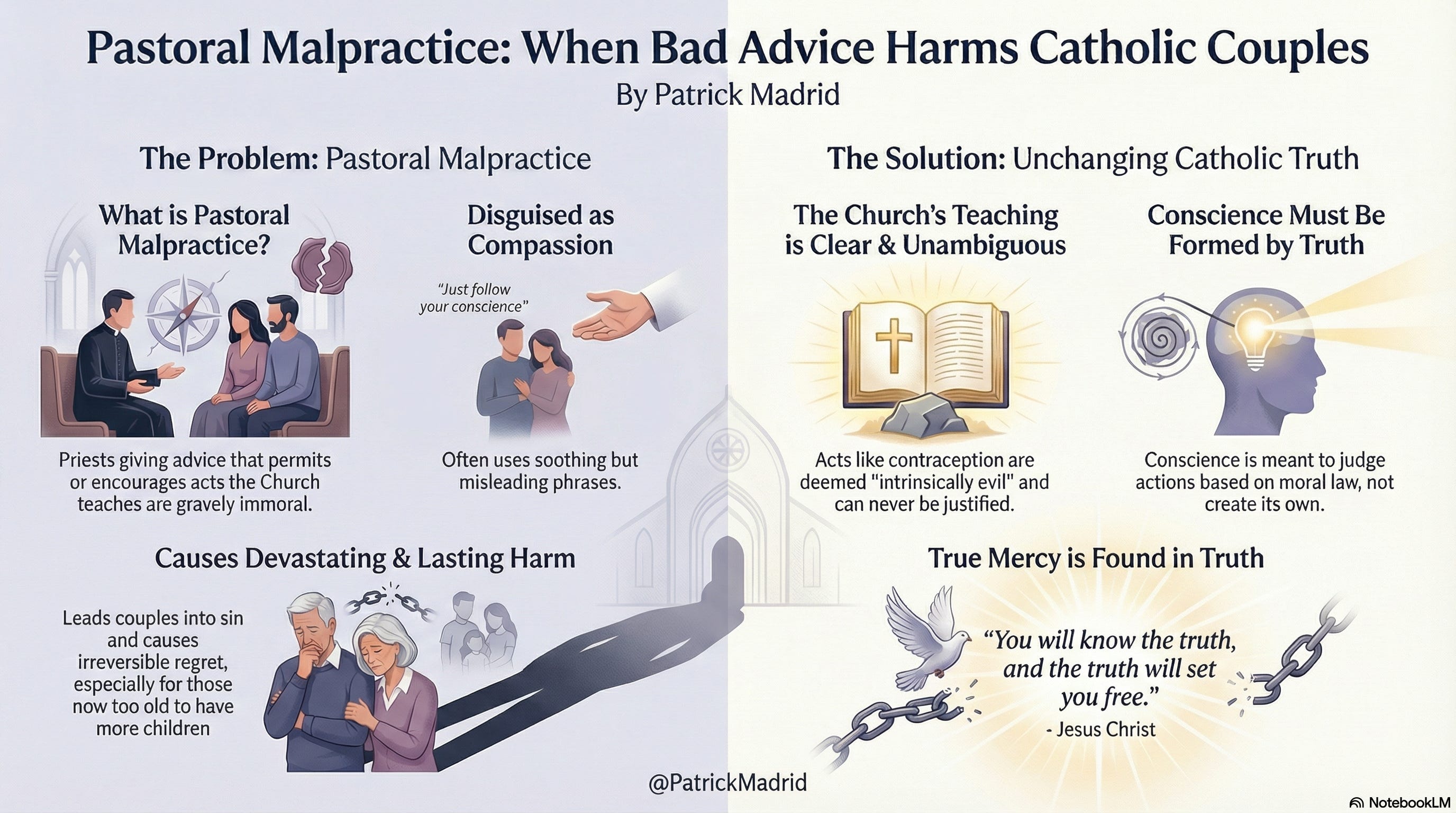
Copyright © 2025 Patrick Madrid. All rights reserved. All text, images, and other original content are the property of the author.
I hope you enjoy my articles here. If so, please tap the Share button above to post any of them on X or Instagram or to send it to someone who might be interested in it. And if you enjoy thoughtful, friendly, faith related content, you’ll appreciate my daily program on Relevant Radio. Listen here or get the free Relevant Radio

In 1986, when my wife and I went through Pre-Cana, we received no guidance in this regard. The total, in fact, was this: follow your conscience as to family size & timing; follow your conscience as far as birth control went; there’s something called NFP, if you’re interested, call the diocese. I called and was told that an older couple, not part of the diocesan office, would call me. They did and later sent me a how-to packet. Quite the pathetic response from our pastoral leadership.
Hi Patrick, thank you for your thoughtful article and reminder of moral truths. On a parallel topic regarding morality, I’ve been slowly coming to terms with being somewhere on the sexuality spectrum as a single man. I have found social media to be filled with gay Catholic men, including priests, who have used the primacy of conscience to condone a variety of same sex behaviors, similar to the birth control argument. I was shattered for a time, tempted to just throw out the baby with the bath water, a true crisis of faith.
I feel grateful to have reasonable formation throughout my years. It really led me to reflect inward and realize the Church belongs to Jesus, not these people.
Pastoral malpractice is a perfect phrase for it all. To a large degree I feel like I am a victim of this pastoral malpractice. “It is better for a millstone…” feels right as I reflect back on the temptations spoon fed to me by clergy and influencers. I feel anger toward these men, as I’m sure many of these couples and individuals from your article feel. I hope to be able to pray for them more going forward, maybe God can make sense of it.