

The Catholic Ten Commandments Explained
Understanding why the Church numbers them the way it does

I REMEMBER BEING caught off guard years ago when someone asked me why the Catholic Church numbers the Ten Commandments differently than Protestants do.
“What?” I said, genuinely unsure what he meant. I had never noticed a difference. This was long before I began working in Catholic apologetics, so I didn’t have an answer on the spot. But I looked it up and discovered not only that a real difference exists, but that there are two specific, historically grounded reasons why the Catholic and Protestant versions diverge.
Both reasons are worth understanding.
The Catholic version follows St. Augustine (354-430), St. Jerome (circa 342-420), and the Jewish tradition drawn from Deuteronomy 5:6–21. In this tradition, the prohibition against graven images is contained within the First Commandment prohibiting the worship of false gods, rather than listed as a separate and distinct commandment.
Far from being a sleight of hand or an attempt to minimize the importance of the condemnation of idolatry with graven images, the Catholic approach follows the inner logic the biblical text itself. Idolatry is not a category separate from having “other gods before me.”
This is because worshipping a graven image is one of the basest examples of it.
St. Augustine explained that the fashioning and worship of an image is not a distinct moral category of sin, but an example of the sin of idolatry.
“The making of an idol and the worship of a god other than the one true God are not two commands, but one. For whoever makes an idol for worship departs from Him who alone is to be worshiped.”
—St. Augustine, Quaestiones in Heptateuchum 2.71
This vital principle is why the Catholic Church teaches that making a graven image for the purpose of idolatry (i.e., worshipping that image) is not a separate sin from worshipping any other form of a false god .
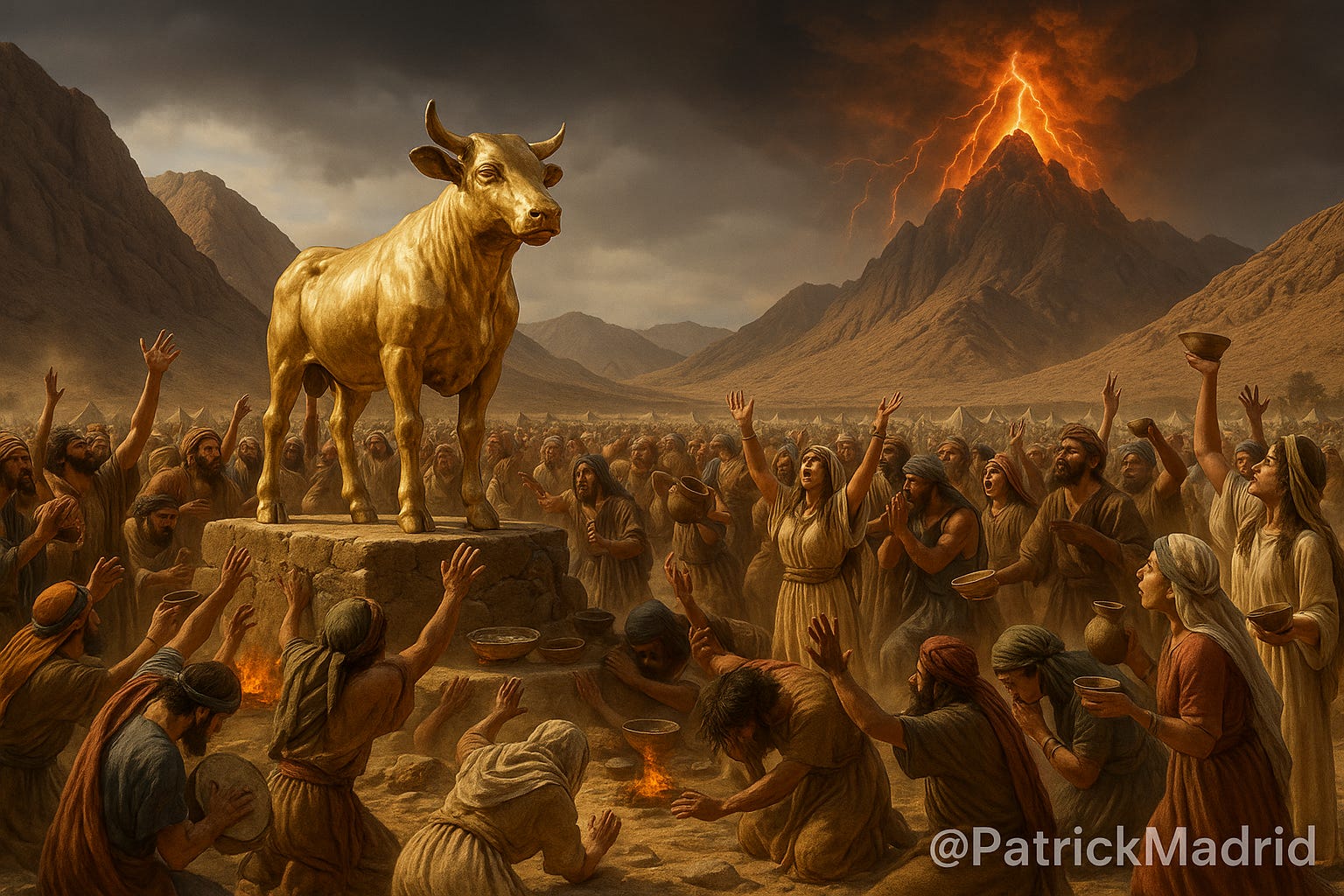
The golden calf episode in Exodus 32:1-8 shows this clearly. The Israelites did not imagine that they had made a “new god” to worship, they identified the calf statue with the Lord who brought them out of Egypt. Their sin was false worship, and the statue was the physical expression of that false worship (see St. Thomas Aquinas, Summa Theologiae, II–II, q. 94, a. 4, ad 1).
The Golden Calf: Why Graven Images Belong Under “No Other Gods”
“When the people saw that Moses delayed to come down from the mountain, the people gathered themselves together to Aaron, and said to him, ‘Up, make us gods who shall go before us; as for this Moses, the man who brought us up out of the land of Egypt, we do not know what has become of him.’
And Aaron said to them, ‘Take off the rings of gold which are in the ears of your wives, your sons, and your daughters, and bring them to me.’ So all the people took off the rings of gold which were in their ears, and brought them to Aaron.
And he received the gold at their hand, and fashioned it with a graving tool, and made a molten calf; and they said, ‘These are your gods, O Israel, who brought you up out of the land of Egypt.’
When Aaron saw this, he built an altar before it; and Aaron made proclamation and said, ‘Tomorrow shall be a feast to the LORD.’
And they rose up early on the morrow, and offered burnt offerings and brought peace offerings; and the people sat down to eat and drink, and rose up to play.”
—Exodus 32:1–6
This is the Lord’s verdict about their apostasy:
“And the LORD said to Moses, ‘Go down; for your people, whom you brought up out of the land of Egypt, have corrupted themselves; they have turned aside quickly out of the way which I commanded them; they have made for themselves a molten calf, and have worshiped it and sacrificed to it.’”
—Exodus 32:7–8“These are your gods, O Israel, who brought you up out of the land of Egypt.”
—Exodus 32:4
St. Thomas Aquinas understands it this same way. He teaches that idolatry belongs under the First Commandment because it concerns false worship itself, not because a graven image was involved.
“Idolatry belongs to the sin of unbelief by giving divine honor to what is not God, and this pertains directly to the First Commandment.”
— Summa Theologiae II-II, q. 94, a. 1
St. Thomas, like all the doctors of the Catholic Faith, clearly distinguishes between idol worship and the legitimate veneration of sacred images:
“The honor shown to the image passes to its prototype . . . Therefore the worship of latria is not given to the image of Christ [as though to the wood or stone], but to Christ Himself.”
— Summa Theologiae III, q. 25, a. 3“Since Christ is adored with the adoration of latreía, it follows that His image should be adored with the adoration of latria.”
— Summa Theologiae III, q. 25, a. 3, ad 3
In other words, the reverence for, say, a crucifix, is directed to Jesus Christ, not to the material image itself. This is the Catholic understanding of venerating icons and statues while rejecting and condemning idolatry. This distinction keeps the emphasis where the Bible places it: on the human heart’s fidelity to the one true God Who alone we worship (see Exodus 20:3, Revelation 19:10).
Why the Ninth and Tenth Commandments Are Kept Separate: Lust Is Not the Same as Greed
The Catholic Church distinguishes between the Ninth and Tenth Commandments also because of the internal logic of the biblical text. The prohibition against coveting your neighbor’s wife (or husband) is much different from coveting his goods. It goes without saying that his wife is not chattel property the way his car or a lawnmower is. These are two distinct, completely different sins, not variations of the same sin.
Coveting (i.e., lusting after) another man’s wife is not simply envy or avarice, it’s a mental sexual sin directly related to if distinct from the physical sin of adultery itself. Jesus declares this connection, saying:
“Everyone who looks at a woman lustfully has already committed adultery with her in his heart.”
—Matthew 5:28
This is why St. Augustine insisted on numbering the 9th and 10th commandments (coveting your neighbor’s wife and coveting his chattel property), because they are two separate and distinctly different categories of sin:
“In desiring the wife of another man, the heart commits adultery; but in desiring his goods, the heart burns with avarice (a disordered, inordinate love of wealth or another’s goods). The law separates these because the vices themselves are not the same.”
—St. Augustine, De Sermone Domini in Monte 1.13.39
Similarly, St. Thomas makes the same point insofar as the objects of these two sins are different, therefore the sins themselves are different:
“Concupiscence directed toward another’s wife is referred to lust, whereas concupiscence for another’s goods is referred to avarice. The precepts are diverse because the vices are diverse.” (Concupiscence here means an inordinate desire, in this case a sexual desire, lust, for a married woman [or man] vs. desire for possessions, which is the vice of avarice).
—St. Thomas Aquinas, Summa Theologiae I-II, q. 100, a. 5
When some Christian traditions combine these into one commandment, an important biblical nuance, one the Church Fathers and the different wording of the commandments found in Exodus and Deuteronomy, become obscured.
Catholics treat the image prohibition as part of the First Commandment because it illustrates idolatrous worship of a false god rather than introducing a second category of sin, while coveting is divided into two commandments, 9th and 10th, to distinguish lust for another man’s wife from avarice for his material goods. These are different interior acts, morally and spiritually. Coveting a neighbor’s lawn mower is not the same thing as coveting his wife.
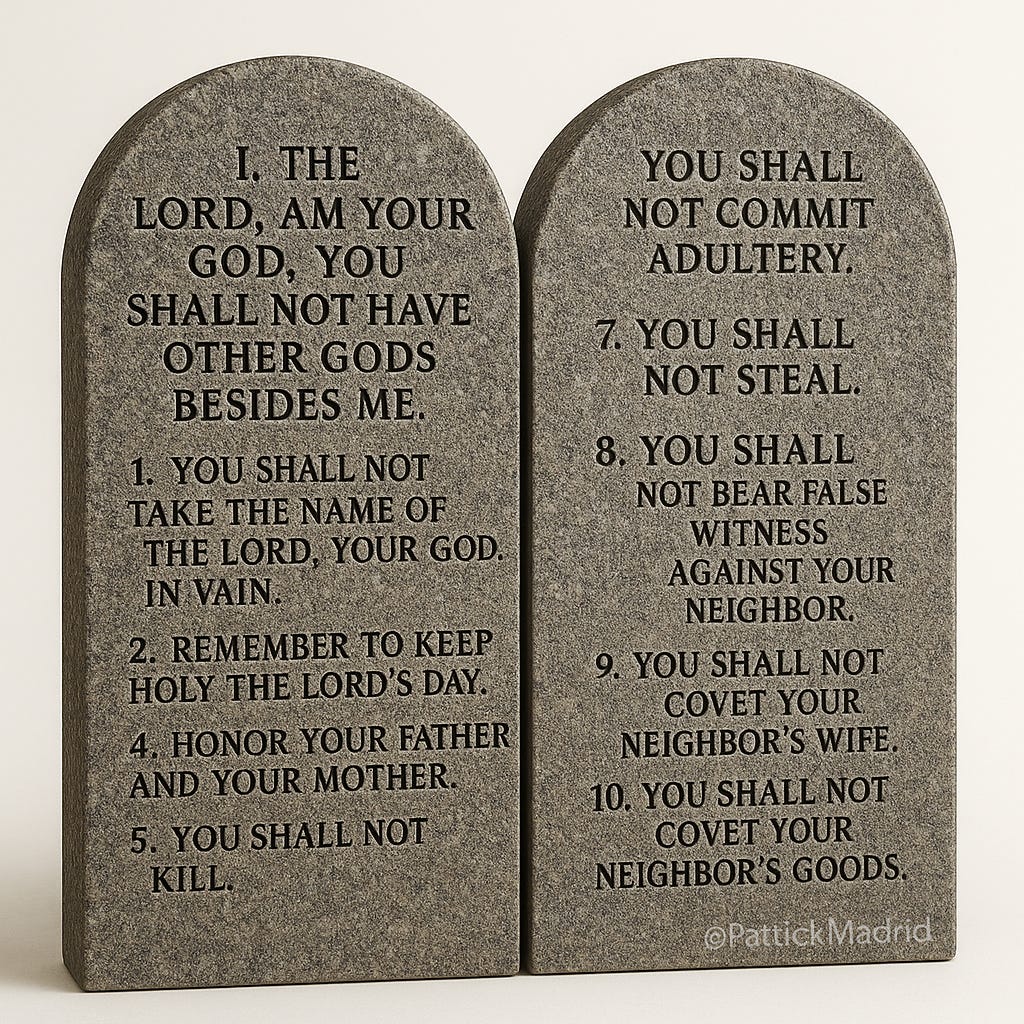
Three Historic Ways of Numbering the Commandments
Many Protestants, following an approach stretching back to some of the Greek Fathers, see the prohibition of graven images as a distinct Second Commandment. This too preserves the fuller biblical command to worship God alone.
Some Jewish sources, such as the Mekhilta (an early rabbinic commentary on Exodus), treats the ban on images as an emphasis on fidelity to the God who brought Israel out of Egypt.
The Eastern Orthodox Churches follow the Greek patristic tradition associated with Origen (185-253) who drew from Jewish philosopher Philo of Alexandria (c. 20 BC–AD 50), and Flavius Josephus (AD 37–c. 100), the Hellenistic Jewish historian, both of whom number the 10 Commandments that way (see Philo, On the Decalogue 52–53; Josephus, Antiquities of the Jews 3.91–97), a structure that later influenced both Eastern Orthodox and Reformed Protestant numbering of the Commandments. They present the prohibition of graven images as a distinct Second Commandment, warning against the idolatrous misuse of images while, the the case of the Orthodox, affirming the veneration of icons. The Church in the East and West thus teach the same doctrinal truth but via different catechetical approaches to the issue of idolatry.
There is no need to pit Augustine against Origen, as both belong to the shared patrimony of the Catholic Church and its biblical heritage. These conventions for numbering the Commandments, Augustinian in the West and Origenian in much of the East, are compatible though distinct. As the Catechism of the Catholic Church says,
The division and numbering of the Commandments have varied in the course of history. The present catechism follows the division of the Commandments established by St. Augustine, which has become traditional in the Catholic Church. It is also that of the Lutheran confessions. The Greek Fathers worked out a slightly different division, which is found in the Orthodox Churches and Reformed communities (2066) .
This distinction doesn’t change the substance of the Decalogue’s prohibition against worshipping false gods, a principle all Christian traditions hold to.
Side-by-Side Summary of the Traditions
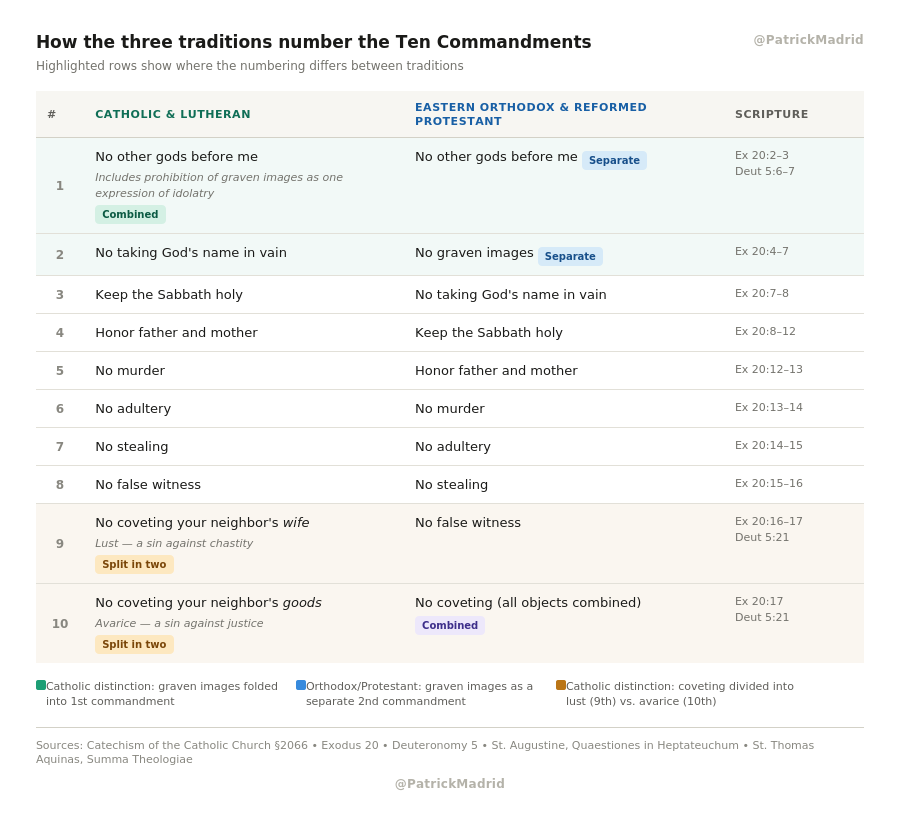
Graven images (Exodus 20:4–6).
Eastern Orthodox and many Reformed Protestants present this as a separate command, highlighting the danger of icons and other images in worship. Catholics and Lutherans include this prohibition within the First Commandment because, in biblical context, it is the most direct expression of having ‘other gods.’
This structure keeps the focus on exclusive allegiance to the true God, while the alternative numbering tradition pursues the same goal by treating it as a separate commandment. This Catholic approach emphasizes the importance of our absolute allegiance to God rather than repeating the same moral category twice.
Coveting (Exodus 20:17; Deuteronomy 5:21).
Some Protestant and Eastern traditions combine all coveting into one command. As mentioned, the Catholic Church preserves the biblical distinction between coveting a neighbor’s wife and coveting his possessions.
The biblical text itself varies the order (wife first in Deuteronomy, property first in Exodus), and the Catholic numbering convention respects that important nuance. These variations are catechetical rather than doctrinal. Rabbinic convention emphasizes the ban on graven images as the Second Commandment (see “The Ten Commandments” article at My Jewish Learning).
A Final Thought
All Christian traditions affirm the full text of the Decalogue. No words are added. None are removed. As the Catechism observes (CCC 2066), the variations in numbering benefit catechesis, and Catholics, Orthodox, and Protestants all condemn idolatry and affirm the interior dimension of sin, even though Protestants do not generally affirm, and some even condemn, the legitimate biblical role of graven images in worship.
The fundamental truth is that worship belongs to God alone, and the human heart must always guard against idolatry in any form.
Then I fell down at his feet to worship him, but he said to me, “You must not do that! I am a fellow servant with you and your brethren who hold the testimony of Jesus. Worship God” (Revelation 19:10).
Postscript:
For a detailed look of the biblical teaching on the legitimate use of religious images vs. the sin of idolatry, see my article: “Do Catholics Worship Statues?”
Copyright © 2025 Patrick Madrid. All rights reserved. All text, images, and other original content are the property of the author.
I hope you enjoyed this article. If so, please tap the Share button above to post this or any of my other free articles to your X, Facebook, or Instagram pages or to send it to someone who might be interested in it. And if you enjoy thoughtful, friendly, faith related content, you’ll appreciate my daily program on Relevant Radio. Listen here or get the free Relevant Radio app.

Thank you for this succinct explanation.
As a side note: Ex. 20 and Dt. 5 reverse the order of the 9th. & 10th. Commandment.
Ex. 20:17 places not coveting a neighbor's goods before his wife, while Dt. 5:21 places not coveting a neighbor's wife before his goods.
I like Dt. better than Ex. ;)