

Do Catholics Worship Statues?
What the Bible teaches about sacred images and how Catholics practice it

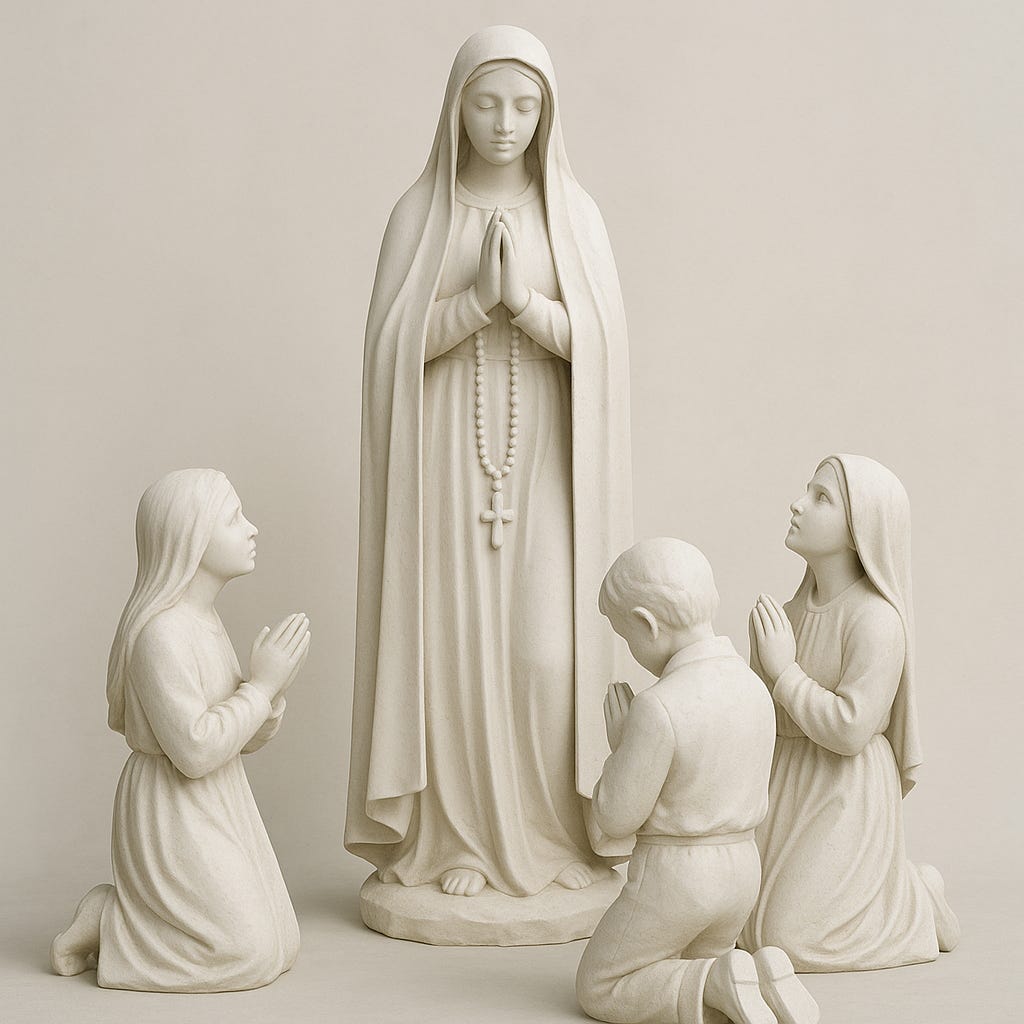
WHEN I ARRIVED one evening years ago at a suburban Chicago parish to conduct an apologetics seminar, something on the rectory lawn caught my eye. A life-sized statue of Our Lady of Fatima stood at the center. Kneeling before it were three smaller statues of Lucia, Francisco and Jacinta, the children to whom Our Lady appeared at Fatima in 1917, their carved heads bowed in prayer toward the larger figure.
I turned to my colleague and joked, “What a great religion Catholicism is. Not only can we worship statues, but our statues can worship statues.” The absurdity made us both laugh.
Later that evening I shared the story during the seminar. The Catholics laughed again, but several of the Protestants did not. Their puzzled expressions revealed something I have encountered many times over the years. Some, including a local Baptist minister in attendance that evening, sincerely believed that Catholics do worship statues. During the Q and A session he stepped to the microphone and, with complete seriousness, asked why the Catholics had laughed at my remark “because we all know that you Catholics do worship statues.”
The next several minutes were spent addressing his concern and explaining that it rests on a misunderstanding of Scripture, which condemns idolatry yet also allows for the legitimate use of sacred images such as statues and icons.
What Scripture Condemns and What It Does Not
The biblical warnings against idolatry are unmistakable.
“You shall have no other gods before Me. You shall not make for yourself a graven image, or any likeness of anything that is in heaven above, or that is in the earth beneath, or that is in the water under the earth. You shall not bow down to them or serve them” (Ex 20:3 to 5).
“Cursed be the man who makes a graven or molten image, an abomination to the Lord” (Deut. 27:15).
St. Paul writes:
“Therefore, my beloved, shun the worship of idols” (1 Cor 10:14).
The Catechism of the Catholic Church states:
“Idolatry consists in divinizing what is not God. It is a perversion of man’s innate religious sense” (CCC 2113).
Notice, though, that the Bible does not forbid the making religious images in certain contexts, though it sternly forbids worshipping them, which is the sin of idolatry. That distinction becomes clearer when we consider how God Himself commands sacred images to be made.
Protestants emphasize the Second Commandment’s gravity against idols, but Scripture’s own commands show that it is the heart’s allegiance, rather than the existence of images, a crucially important distinction (cf. 1 Samuel 16:7). Catholic and Jewish traditions number the commandments differently, treating the prohibition of idolatry as a unified command, while some Protestant Bibles divide it to emphasize images specifically. The pagan context, such as the golden calf incident, targeted false worship rather than the Temple art God later required.
Deuteronomy 4:15-19 prohibits images of God Himself to prevent misrepresentation in the era before the Incarnation of Jesus, which now resolves that very concern.
Some Protestant reformers, such as John Calvin (1509–1564), argued that any depiction of the invisible God (cf. Jn 4:24, “God is spirit”) inherently violates this command and risks idolatry. Martin Luther (1483–1546) was more permissive, viewing images as helpful teaching tools while rejecting their veneration as unnecessary and prone to abuse.
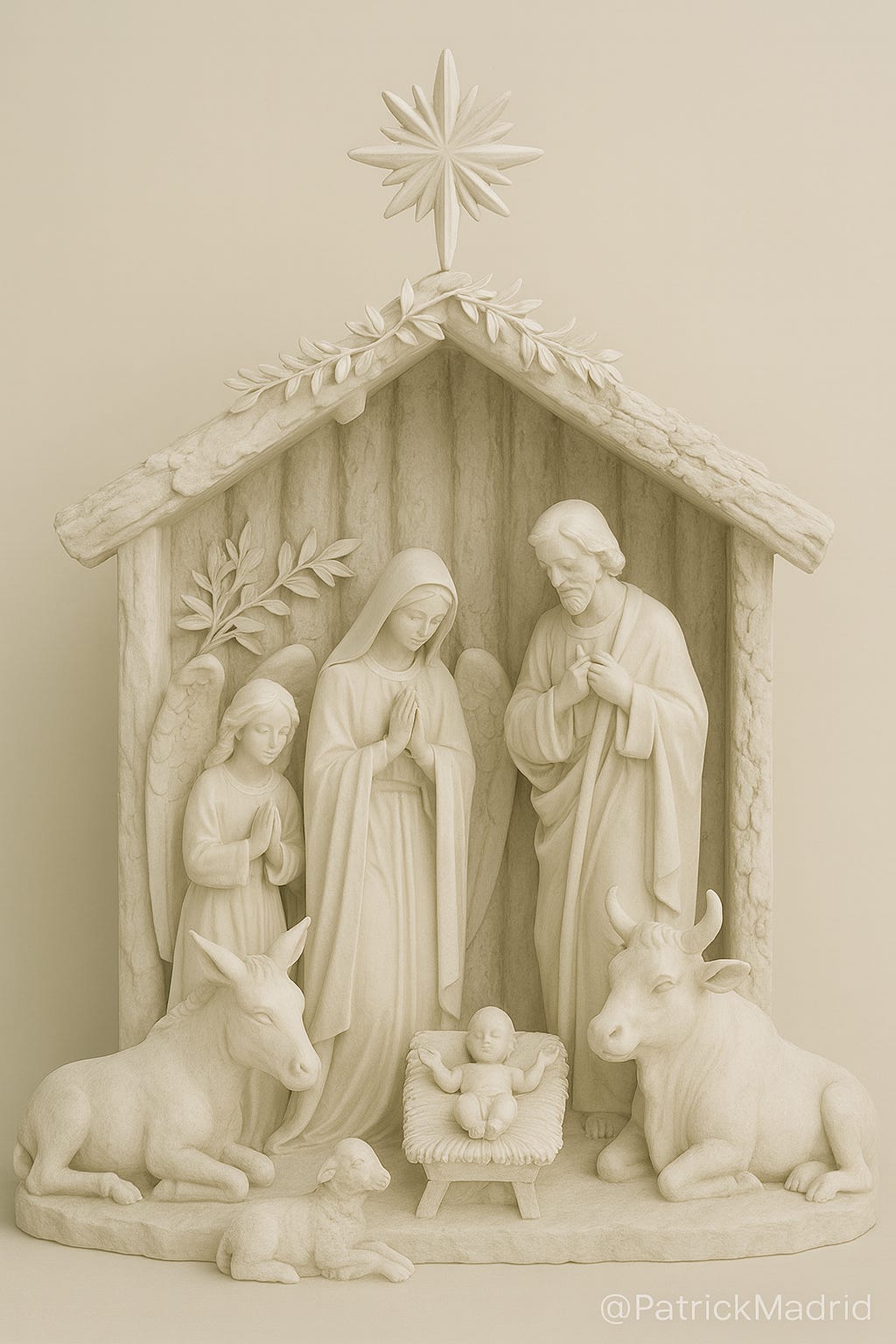
Catholic teaching responds that the Incarnation of Jesus, Who is “the image of the invisible God” (Col 1:15), is proof that by virtue of the Incarnation it cannot be sinful in itself to represent God in an image. Think: crucifixes, manger scenes with Baby Jesus,” etc. The Greek word εἰκών (eikon), the root of the word icon. The Incarnation brings visible representation into the heart of Christian faith.
When God Commanded Graven Images
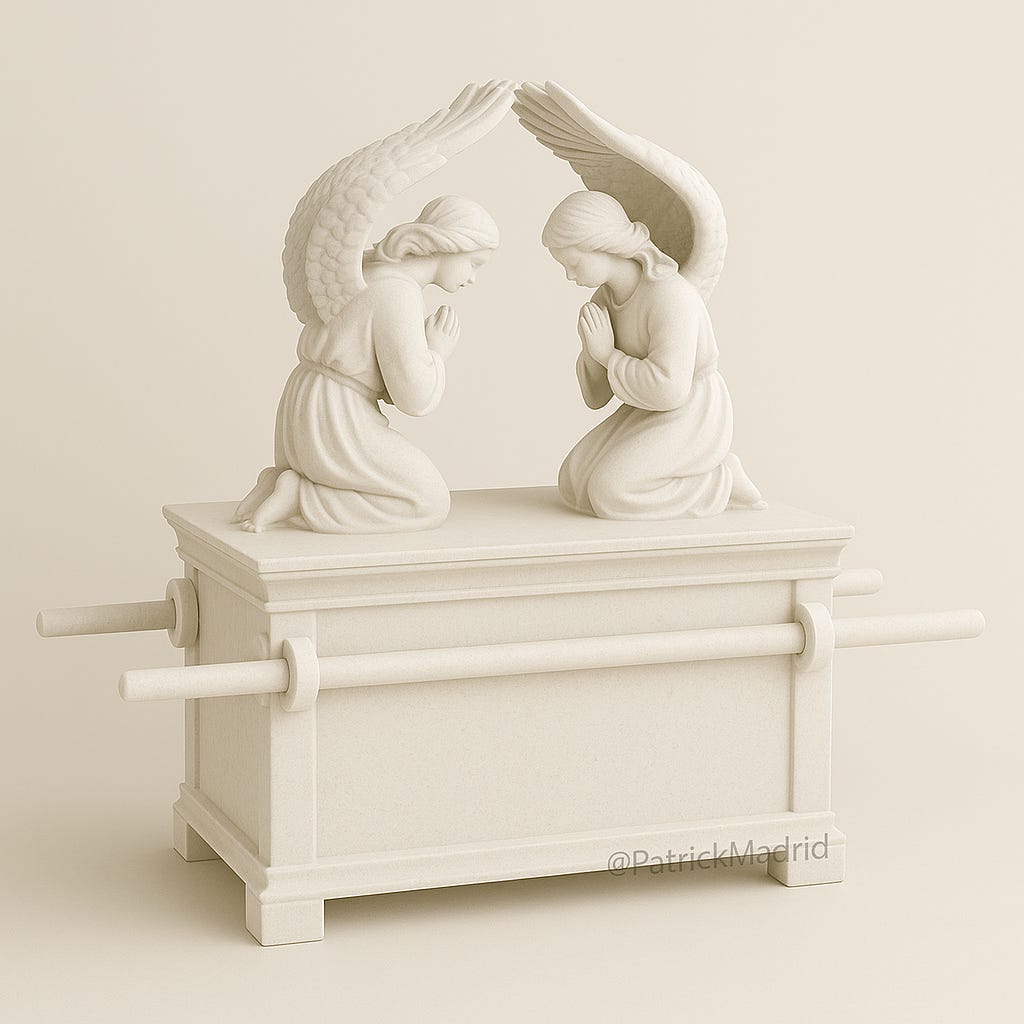
In Exodus 25, God instructs Moses to fashion two graven images of golden cherubim for the Ark.
“You shall make two cherubim of gold. The cherubim shall spread out their wings above. Toward the mercy seat shall the faces of the cherubim be. There I will meet with you” (Ex 25:18 to 20 and 22).
God’s command to fashion these graven images stands as incontrovertible proof that images used legitimately for religious purposes (e.g., a crucifix) are not intrinsically sinful.
Other examples confirm this pattern.
Aaron’s vestments are decorated with embroidered pomegranates (Ex 28:31 to 34).
Moses is commanded to make a bronze serpent that brings healing to those who look upon it (Num 21:8 to 9). Jesus later identifies this serpent as a foreshadowing of His crucifixion (Jn 3:14).
Solomon’s Temple is filled with carved angels, palm trees, oxen, lions and flowers (1 Kings 6 and 7).
God responds to all of these graven images in the Temple by blessing it:
“I have hallowed this house. My eyes and My heart shall be there perpetually” (1 Kings 9:3).
If the existence of images were sinful in itself, God would not command them, sanctify them or associate His presence with them.
When a Sacred Image Becomes an Idol
The bronze serpent eventually became an object of superstition. King Hezekiah destroyed it once it was being misused.
“He removed the high places, and broke the pillars, and cut down the Asherah. And he broke in pieces the bronze serpent that Moses had made, for until those days the people of Israel had burned incense to it; it was called Nehushtan”
(2 Kings 18:4).
The problem was not the Bronze Serpent itself (after all, God commanded it to be made), but the idolatrous worship offered to it by the people. The same distinction still applies today. Sacred images can be helpful or harmful depending on how they are treated.
The Catholic Church acknowledges this dichotomy clearly, warning against idolatry (CCC 2112 to 2114).
The first commandment condemns polytheism. It requires man neither to believe in, nor to venerate, other divinities than the one true God. Scripture constantly recalls this rejection of “idols, [of] silver and gold, the work of men's hands. They have mouths, but do not speak; eyes, but do not see.” These empty idols make their worshippers empty: “Those who make them are like them; so are all who trust in them.” God, however, is the “living God” who gives life and intervenes in history (2112).
Idolatry not only refers to false pagan worship. It remains a constant temptation to faith. Idolatry consists in divinizing what is not God. Man commits idolatry whenever he honors and reveres a creature in place of God, whether this be gods or demons (for example, satanism), power, pleasure, race, ancestors, the state, money, etc. Jesus says, “You cannot serve God and mammon.” Many martyrs died for not adoring “the Beast” refusing even to simulate such worship. Idolatry rejects the unique Lordship of God; it is therefore incompatible with communion with God (2113).
Human life finds its unity in the adoration of the one God. The commandment to worship the Lord alone integrates man and saves him from an endless disintegration. Idolatry is a perversion of man’s innate religious sense. An idolater is someone who “transfers his indestructible notion of God to anything other than God” (2114).
What Catholics Actually Do
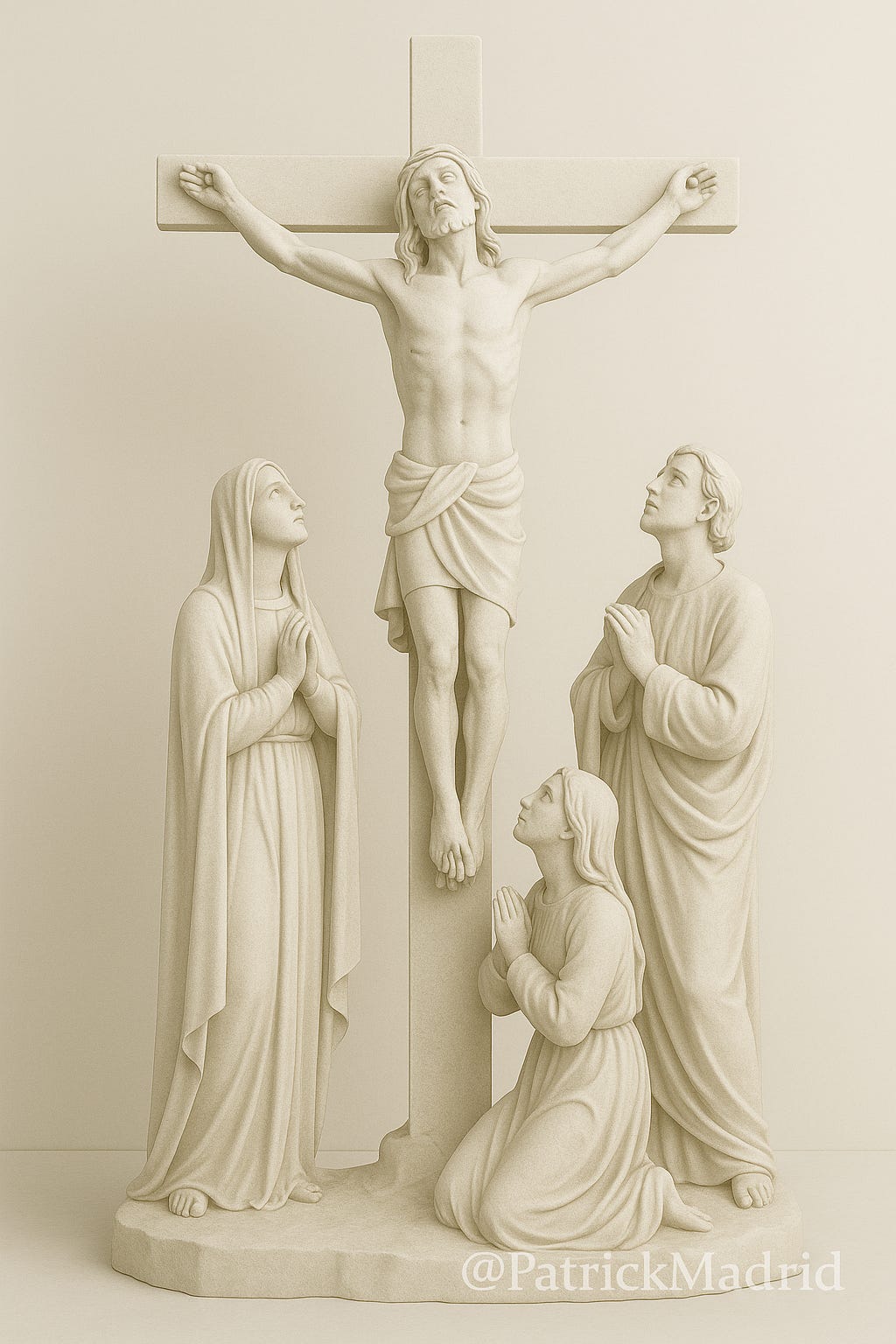
Catholics do not worship statues. The Catholic Church, from the Bible, absolutely forbids it. But Catholics do use images in the same way God instructed Israel to use them. They serve as visual reminders that lift the mind toward the heavenly realities they signify. Some might see a Catholic bow before a statue and ask, “Doesn’t that look like worship?” Appearance matters (see Exodus 32:4 to 5), but the Bible makes a clear distinction between reverence (veneration) from worship.
St. Peter emphatically refuses adoration in Acts, as does the angel in Revelation, precisely because the gestures were misdirected toward creatures instead of to God who alone can be worshipped.
“When Peter entered, Cornelius met him and fell down at his feet and worshiped him. But Peter lifted him up, saying, ‘Stand up; I too am a man’” (Acts 10:25 to 26).
And in the Book of Revelation, even St. John the Apostle himself fell at the feet of an angel to worship him. The angel’s sharp rebuke is immediate:
“Then I fell down at his feet to worship him, but he said to me, ‘You must not do that. I am a fellow servant with you and your brethren who hold the testimony of Jesus. Worship God’” (Rev 19:10).
As if that weren’t enough to prevent him from doing that again, it happened again!
“I fell down to worship before the feet of the angel who showed them to me, but he said to me, ‘You must not do that . . . I am a fellow servant with you and your brethren the prophets… Worship God’” (Rev 22:8 to 9).
This is especially striking. Saint John knew Jesus personally, he lived with Him for three years, saw the miracles, heard the teachings, and stood faithfully at the foot of the Cross beside the Blessed Virgin Mary, steadfast till the end. Yet even he momentarily misdirected an act of worship. In important reminder that worship belongs to God alone, as Catholic teaching has always emphasized.
St. Thomas Aquinas: How Honor Works
The Catholic Church emphasizes the distinction between veneration or honor (Greek: δουλεία, duleía) and worship (latreía) due to God alone. St. Thomas Aquinas (1225–1274) explains that reverence shown before a sacred image is not directed toward the material object.
“The honor given to an image is a relative honor. For the honor paid to the image passes to the prototype” (Summa Theologiae III, q.25, a.3).
“We do not venerate images for their own sake, but in so far as they represent Christ” (III, q.25, a.3 ad 2).
St. John Damascene: The Incarnation of Jesus Makes Images Possible
During the iconoclastic crisis of the eighth century, St. John Damascene (c. 675–749) offered a decisive explanation rooted in God becoming man in the Incartation.
“I do not worship matter. I worship the God of matter, who became matter for my sake. I will not cease to honor the matter through which my salvation came.”
On the Divine Images I.16
This teaching echoes earlier pre-schism Eastern Fathers. for example, St. Basil the Great (c. 330–379), in On the Holy Spirit (ch. 18), taught the same principle:
“The honor paid to the image passes on to the prototype.”
He illustrates this principle with the example of the emperor’s image, showing that honor to the image is honor to the emperor himself.
St. Athanasius (c. 296–373), writing in Against the Arians (3.5), taught the same truth:
“He who bows to the picture, bows to the Emperor; for the image of the Emperor is his likeness and form.”
This analogy shows how reverence directed toward a representation points beyond itself to the one who is represented.
St. Gregory of Nyssa (c. 335–394) likewise defended sacred images. In his letters he opposes their destruction and describes devotional paintings that reminded people of God and His saints without lapsing into idolatry. Icons and images of biblical scenes, such as the birth and baptism of Christ or the Annunciation, moved viewers to repentance, prayer, and deeper love of God.
The Eastern Orthodox Churches speak of icons as “windows to heaven” that facilitate our souls and senses being lifted upward toward God and heavenly realities. This reflects the Catholic-Orthodox consensus that the proper use of religious images affirms the Incarnation of Jesus rather than detracts from it.
The Second Council of Nicaea
In AD 787, the Second Council of Nicaea settled the controversy over icons and affirmed their rightful place in Christian piety and worship.
“The honor paid to the image passes to its prototype, and whoever venerates an image venerates in it the person portrayed.”
Nicaea II, Definition of Faith (DS 600–603)
The council drew the essential distinctions:
Worship, λατρεία (latreía), belongs to God alone.
Veneration, προσκύνησις (proskýnēsis), may be offered to Mary and the saints and to their images.
This distinction is reaffirmed throughout the Church’s magisterial teachings:
“We define that the holy icons… are to be venerated (προσκυνεῖσθαι, proskynéisthai) . . . but the true worship (ἀληθινὴ λατρεία, alēthinē latreía) is to be given to God alone.” Second Council of Nicaea, AD 787 (Denzinger 302 / DS 600–603)
“The Christian veneration of images is not contrary to the first commandment . . . The honor rendered to an image passes to its prototype.”
Catechism of the Catholic Church 2131–2132“Images . . . are to be retained… not that any divinity or power is believed to be in them . . . but because the honor shown to them is referred to the prototypes they represent.” Council of Trent, Session 25 (DS 1821–1825)
“The worship of latreia is due to God alone . . . The honor given to saints is called dulia, and to the Blessed Virgin hyperdulia, all essentially distinct from the worship of latreia.” Catholic Encyclopedia (1913), “Veneration” / “Idolatry”
“Latreía (adoration) is due to God alone. Duleía (veneration) is due to the saints, while hyperduleía is accorded uniquely to the Mother of God.” Ludwig Ott, Fundamentals of Catholic Dogma, Book III, Part 3, Ch. 2 (see pages 215-216).
The Biblical Distinction Between Worship and Honor
The Bible consistently distinguishes different kinds and degrees of honor without ever equating them with divine worship.
Jesus quotes Deuteronomy 6:13 when rebuking Satan:
“You shall worship (προσκυνήσεις / proskynēseis, from προσκύνησις — proskýnēsis) the Lord your God, and Him only shall you serve (λατρεύσεις / latreuseis, from λατρεία — latreía).”
(Matt 4:10)
St. Paul instructs:
“Render to all what is due them . . . honor (τιμήν / timēn) to whom honor is due.”
(Rom 13:7)“Let the elders who rule well be considered worthy of double honor (διπλῆς τιμῆς / diplēs timēs).”
(1 Tim 5:17)
St. Peter says:
“Honor (τιμήσατε / timēsate) all people… honor (τιμᾶτε / timate) the king.”
(1 Pet 2:17)
None of these mentions of timē (honor) or proskýnēsis (reverence that may be shown to creatures) are treated as violations of the exclusive latreía of worshop and adoration which human beings and angels owe to God alone. The New Testament provides us with these distinctions before the additional theological terms were developed.
Protestant critics sometimes object that Catholics and Eastern Orthodox simply “invented” Greek labels to disguise what appears to be in all actuality worship of Mary or the saints. But that argument won’t fly due to the already established biblical vocabulary and distinctions regarding how reverence (proskýnēsis and timē) may rightfully be shown to creatures, while worship and adoration (latreía) is strictly reserved solely for God.
Early Church Fathers made this same biblical distinction. St. Augustine (354–430), in City of God X.1–2, teaches that Christians do not offer latreía (sacrifice or divine worship) to the martyrs, but only honor (timē) to their memory. Far from being a semantic trick, the classic Catholic and Eastern Orthodox distinctions of latreía, hyperdouleía and douleía clearly identify and safeguard the biblical teaching on honor and worship.
The Rise of the Heresy of Iconoclasm (Image Smashing)
In the eighth century the Church faced its most violent challenge to sacred images. This occurred when Byzantine emperors (e.g., Leo III the Isaurian [reigned 717-1741], Constantine V [r. 741–775], and Leo V the Armenian [r. 813–820]), influenced by certain iconoclastic bishops (e.g., Constantine of Nacolia [fl. ca. 720s–730s], Thomas of Claudiopolis [fl. ca. 720s–730s], and Theodosius of Ephesus [fl. ca. 729–after 754]) who correctly recognized that icons and other religious images were a barrier to Muslim conversions, unleashed a sixty-year persecution against those who venerated icons.
Churches were stripped of icons and statues, laws enacted that forbade their possession, and countless monks, priests and lay faithful, including St. John Damascene (c. 675–749) himself, were imprisoned, tortured, and even martyred for refusing to surrender the ancient practice of venerating images.
Far from producing the expected wave of Islamic converts to faith in Jesus Christ, this disastrous policy plunged the Byzantine Empire into decades of violent, bloody strife.
The turning point in the Iconoclast drama came in AD 787 when Empress Irene (752-801) and Pope Hadrian I (700-795) convened the Second Council of Nicaea. Three hundred bishops, most of them from the Eastern Church, examined the question anew. After studying the Bible’s teachings on the topic, as well as the unbroken testimony of the Church Fathers, they solemnly reaffirmed the legitimacy of icons and statues and condemned as heretical both the worship of images and the destruction of them by the iconoclasts.
The iconoclastic controversy reveals a recurring pattern: whenever political or cultural pressure tempts Christians to abandon sacred art out of fear that it “looks like idolatry” to outsiders (whether Muslims then or many Protestants today), the Church has consistently responded that the problem is not sacred images themselves but the misuse of it. Icons and other religious images are biblically legitimate visual aids that lift the mind and heart to God and His angels and saints who see Him face-to-face for eternity in the beatific vision.
The Patristic and Biblical Foundations of Nicaea II
Convened primarily by Eastern bishops and drawing on pre-schism Fathers such as St. Basil the Great (c. 330–379) and St. Athanasius of Alexandria (c. 296–373), the council reflected the shared consensus of the undivided Church before the East–West schism. The Council emphasized the biblical examples of the religious images commanded by God to adorn the Tabernacle and Temple, and also invoked the authority and consistent witness of the early Church Fathers, East and West.
Iconoclasm collapses under the weight of Scripture itself. The most decisive biblical refutation of image-smashing comes from the New Testament’s proclamation that the Son, in becoming man, makes the invisible God visible.
“He is the image (εἰκών / eikṓn) of the invisible God, the firstborn of all creation” (Col 1:15).
The Writer of the Epistle to the Hebrews expresses the same truth:
“He [Jesus] reflects the glory of God and bears the very stamp of His nature”
(Heb 1:3).
In the Incarnation God made Himself depictable. The eternal Word takes on a human face, a human body, a human form, aspects that the human eye can behold and our hands can touch (see 1 John 1:1).
As the Lord Himself plainly teaches:
“He who has seen Me has seen the Father.”
(John 14:9)
One profoundly deep meaning here is that in Christ, the invisible God became visible. And thus, what was prohibited in the Old Covenant — making images of God — is now possible because God has shown His own face to us in and through the Incarnation of Jesus, the Word of God.
Therefore, since Jesus is the eikṓn of the Father, and since the Apostles beheld Him with their eyes, and because the Gospel accounts hand down Divine Revelation about His features, gestures and physical actions, then it follows that depicting Him in sacred art proclaims that He is the very image of the invisible God. The God who took flesh can be depicted. As St. John Damascene said, “I do not worship matter, but the God of matter, who became matter for my sake.” The veneration of icons and other sacred images do not undermine the Gospel; it bear witness to the Gospel, whose center is the visible, tangible, incarnate Son of God.
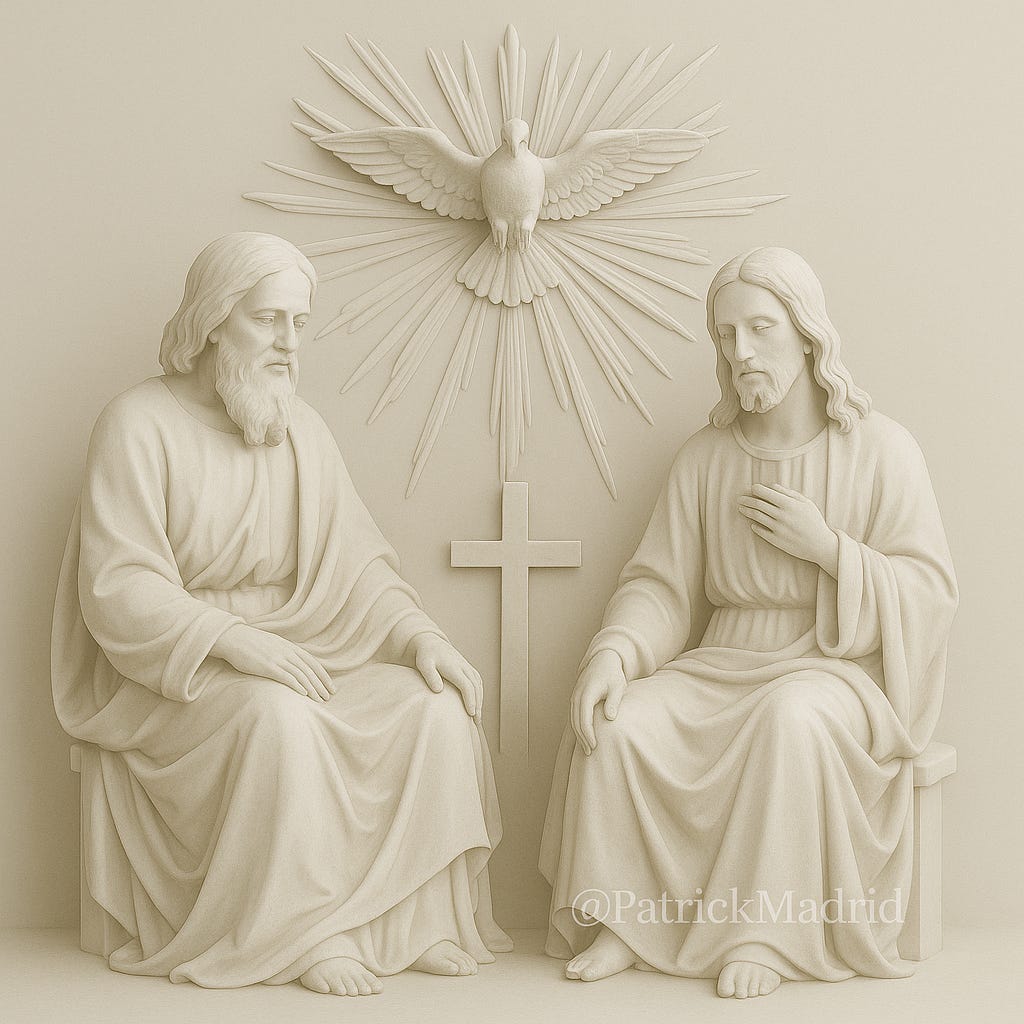
Does Depicting God Break the Second Commandment?
Some Protestants, especially those in the Reformed tradition, will concede that Colossians 1:15 and Hebrews 1:3 call Christ the “image” (eikōn) and “exact representation” of the Father, but will insist these are only metaphors. They argue that any attempt to paint or sculpt the divine nature still violates God’s transcendence and the Second Commandment. They appeal to passages such as: “You saw no form” (Deuteronomy 4:12) and “God is spirit” (John 4:24). From this they conclude that the Old Testament images were purely exceptional, one-time divine orders (e.g., the cherubim atop the Ark, the bronze serpent, the Temple carvings), and not norms for New Covenant worship.
The Catholic Church responds that once the Incarnation happened, the strict prohibition against depicting God “as though He had a form” no longer applies precisely because God now has revealed Himself in visible human form in Jesus Christ. To deny this truth entails a rejection of the power and meaning of the Incarnation and inadvertently places a limit on how God may reveal or represent Himself. But the truth is, “We have seen [Him] with our eyes . . . looked upon and touched with our hands” (1 John 1:1).
The Catechism of the Catholic Church
“The Christian veneration of images is not contrary to the first commandment” (CCC 2131).
“The honor rendered to an image passes to its prototype” (CCC 2132).
All forms of idolatry are condemned CCC 2112 through 2114.
Human beings experience truth and remember it through our five senses. You keep photographs of loved ones because the image reminds you of those persons. You do not confuse the photograph with the ones you love. The same principle applies to sacred images.
Statues, icons and paintings are not objects of worship. They are visual reminders of the invisible realities of faith. They help us recollect, focus and pray. They serve the same purpose as the cherubim above the Ark, the pomegranates on Aaron’s vestments and the carvings in Solomon’s Temple. They point beyond themselves.
No Catholic worships statues. What Catholics do is exactly what Scripture, the Fathers and the Church’s councils affirm. Sacred images, used properly, lead the heart more deeply toward the living God.
Just as you might kiss a picture of your wife or husband or children or someone else whom you love, the kiss (expressing your affection) is not for the image itself but is directed to the person depicted in the picture. The same is true for Catholics who bow or make some gesture of veneration and reverence before a crucifix or icon. The reverence is for the person represented in the image, not for the wood, stone, plaster, or paint upon which the loved on has been represented.
Lift High the Cross
A powerful and dramatic example of what I mean happened at a public apologetics debate I participated in back in 2002. The Protestant debater who challenged me to defend Catholic teaching on Mary and the Saints in a three-hour moderated debate held before a live audience of some 1,000 people spent a great deal of time deriding Catholic teaching on the biblical basis of icons and images. Knowing ahead of time that this would happen, I came prepared with a large wooden crucifix, three feet tall, that remained concealed in a box beneath my table on the debate stage until it was time to reveal it.
Just the right moment arrived when, after the audience had heard a lengthy barrage of my opponent’s arguments against icons and images, I knew it was time to “lift high the cross.”
I told the audience that as long as they had been hearing so much that evening about “sacred images” that it would be instructive to actually see one.
Slowly, I removed the crucifix from the box and held it aloft above my head. For a long pause I silently observed the audience’s reaction. It was clear who the Catholics in the audience were and who were the Protestant. Those who smiled and nodded and, in not a few cases, even applauded, were Catholic. The crucifix did not offend them, the very sight of it energized them and made them happy. Those who either were blank or, worse, were visibly disturbed by the crucifix, I safely knew, were Protestant. The very sight of it, for them, drew frowns and furrowed brows and even a few audible gasps. Very telling.
Then, still holding the crucifix high above my head, I asked the audience rhetorically how they would feel if, God forbid, someone were to spit at this image of Jesus. Or what if someone stomped on it or showed some other blasphemous expression of contempt toward it. “How would you feel about that?” I asked them earnestly. Catholic and Protestant alike, an audible murmuring of dismay and disapproval rippled across the room. Everyone clearly would be offended and angry if such disrespect were shown toward the crucifix.
Waiting again in dramatic silence for a few long moments, I then asked them the proverbial $64,000 Question:
“So if, as everyone can agree, it would be wrong and even blasphemous to show contempt for this image of the Lord Jesus Christ, do you not see why showing respect and reverence toward this same image actually honors Jesus Himself, rather than the wood and paint from which the image is made?”
Talk about seeing a lightbulb go off! It was palpably clear that many Protestants in the audience that evening suddenly understood the issue in a deeper way, transcending Reformation apologetics and polemics.
The looks on their faces told me that, my debate opponent’s arguments notwithstanding, they could now see and understand what Catholics and Eastern Orthodox mean by “venerating” sacred images.
It was powerful, and over the years since, more than a few people who were either present in the audience that evening or watched the video or heard the audio told me what a powerful paradigm shift it was for them and how it helped crystalize in their minds the truth of the Catholic teaching on sacred images. Praise God.
Recommended Reading on Statues, Icons, and Sacred Images
Three Treatises on the Divine Images
St. John of Damascus
(1997, St. Vladimir’s Seminary Press, Popular Patristics Series)
A foundational patristic defense of sacred images grounded in the Incarnation and upheld by Nicaea II.
On the Holy Icons
St. Theodore the Studite
(1981, St. Vladimir’s Seminary Press)
A clear witness from the later iconoclastic struggle explaining how Christian images protect right doctrine.
Discourse Against Those Who Reject the Holy Icons
St. John of Damascus
(Various patristic editions; widely available through St. Vladimir’s Seminary Press collections)
A scriptural and theological refutation of iconoclasm, addressing Exodus 20 and the place of images in Christian worship.
Theology of the Icon
Leonid Ouspensky
(1992, St. Vladimir’s Seminary Press)
A two-volume study offering a thorough account of icon meaning, structure, and theological grounding.
The Meaning of Icons
Leonid Ouspensky and Vladimir Lossky
(1982, St. Vladimir’s Seminary Press)
A trusted introduction to icon symbolism, spiritual purpose, and liturgical use.
Redeeming Beauty: Soundings in Sacral Aesthetics
Aidan Nichols, OP
(2007, Ashgate Publishing)
A Catholic study of beauty and sacred art that places religious imagery within the larger Christian tradition.
Duodecimum Saeculum (“twelve hundredth anniversary” of the Second Council of Nicaea, 787).
John Paul II
(1987, Vatican Publishing Offices)
A reflection on the twelve hundredth anniversary of Nicaea II and the Church’s teaching on the veneration of images.
Letter to Artists
John Paul II
(1999, Vatican Publishing Offices)
A concise meditation on the vocation of the artist and the place of beauty in the life of the Church.
Copyright © 2025 Patrick Madrid. All rights reserved. All text, images, and other original content are the property of the author.
I hope you enjoy my articles here. If so, please tap the Share button above to post any of them on X or Instagram or to send it to someone who might be interested in it. And if you enjoy thoughtful, friendly, faith related content, you’ll appreciate my daily program on Relevant Radio. Listen here or get the free Relevant Radio app.

Sometimes a distraction in prayer can be overcome by simply seeing a statue or picture of the Sacred Heart. This turns us back to prayer.
Great article rich in citations from scripture and philosophy. Thank you, this has helped my understanding and my apologetic tool kit :)