

The Doughnut Shop Debate
You Don’t Always Have to Start the Conversation

Deep Dive Podcast
Audio segment generated with AI narration summarizing Patrick Madrid’s written content.
BACK AROUND 1990, I walked into a doughnut shop, set a copy of The Catholic Catechism by John A. Hardon, S.J., squarely on a small table, and headed to the counter for coffee and a doughnut. When I turned back, I noticed a slight change in the room. Conversations slowed. A few people glanced at the book, then at me.
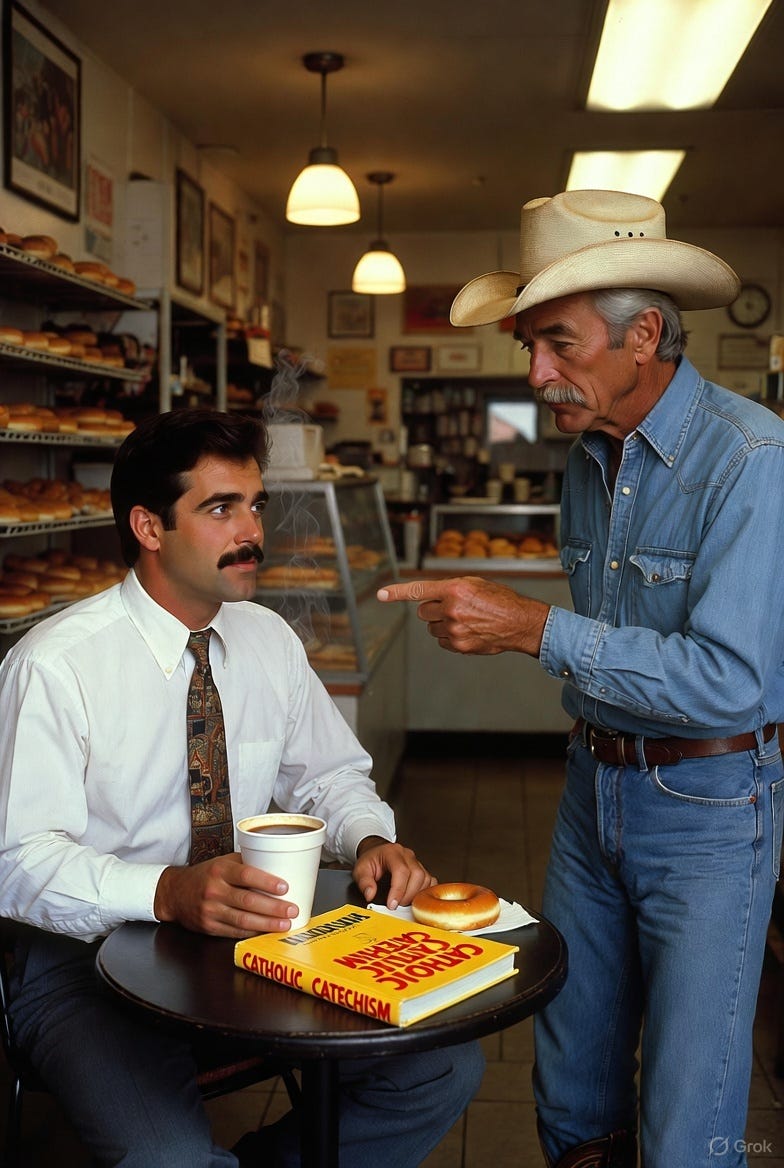
As I turned back to my table, out of the corner of my eye, I saw a sunburned, weathered man in his late sixties staring openly. He wore jeans, boots, and a cowboy hat and looked as though he had stepped out of central casting for a rancher, even though we were in suburban Southern California. He shifted in his chair, clearly unsettled, staring at the book.
Suddenly he blurted out, “Why are you reading that Catholic catechism?” His tone suggested the same alarm someone might use when asking, “Why are you holding that live rattlesnake?”
The shop fell quiet. Before I could respond, he pressed on. “You’re not thinking about becoming a Catholic, are you?” The word “Catholic” slipped from his mouth with open disdain.
Caught a bit off guard but unembarrassed, I forgot all about the doughnut and decided to lean into the discussion.
“Not at all,” I replied, smiling. “As a matter of fact, I’m already a Catholic, and I’m reading this book to become a better one.”
I knew that last line would almost certainly prompt a challenge. I turned the book toward him so he could get a good look at it.
That answer only sharpened his eagerness to confront me. Declaring himself a “Bible-believing Christian,” he announced to everyone within earshot that the “Roman Catholic system” taught “damnable traditions of men.”
Tapping the catechism energetically a few times with his forefinger, he warned me that unless I abandoned catechisms and started reading the Bible, I would remain on the road to hell.
All I had wanted, I thought, was a quick doughnut and a cup of coffee. Instead, I was being publicly lectured by a verse-quoting Fundamentalist, and I loved it, because this kind of impromptu exchange is exactly the sort of discussion I relish.
Granted, I was far more prepared for this encounter than many Catholics would have been. I had the advantage of having spent the past few years doing full-time apologetics at Catholic Answers, which was my secret weapon, one he did not know about. Not that it would have made much difference. He was insistent, emphatically so, that Catholics are not “born again,” and nothing I said was likely to dislodge that conviction.
Still, the fact that I remained calm, stood my ground, and showed no sign of defensiveness clearly surprised him. He had obviously tried this routine before with other Catholics, and unfortunately, probably with some success. I had been in this kind of confrontation countless times, though, and it did not bother me in the least.
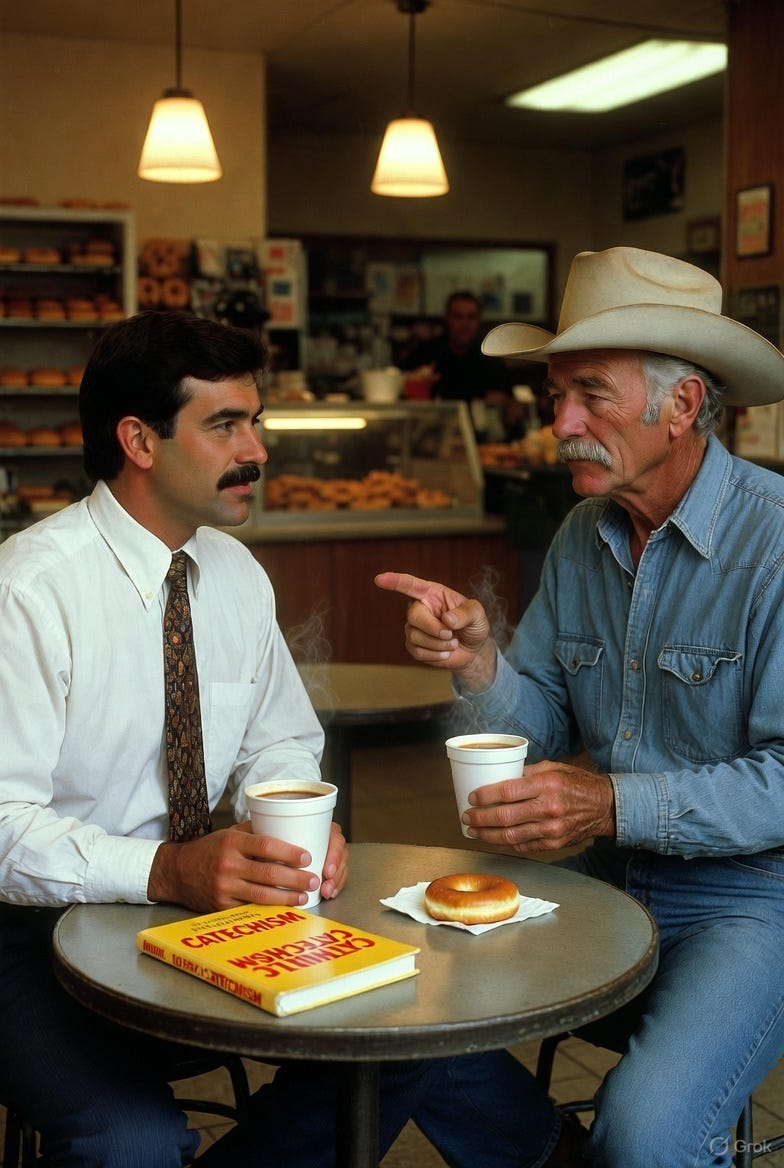
Without me inviting him to do so, Cowboy Guy sat down at my table and for the next several minutes, jumped from objection to objection. Statues. Mary. The Eucharist. Confession to a priest. Authority. Each came wrapped in King James Bible verses delivered with confidence and volume.
None of my equally rapid-fire answers changed his mind, but he seemed surprised and a little frustrated that I could respond clearly and coherently without getting ruffled by his unsuccessful attempts to buffalo me.
It appeared he expected me to fumble or retreat. When I did neither and instead pushed back politely with Bible verses of my own against each of his boilerplate objections to the Church, the wind seemed to go out of his sails. Gradually.
Nothing I said changed his mind, but eventually, seeing that I would not yield and was not intimidated by his torrent of challenges, he ended the exchange, walked out, climbed into his pickup truck, and drove off.
Only later did it occur to me that I had not started the conversation at all.
The book had. All I had done was simply set it down and let it speak for itself.
That detail matters. This encounter took place shortly before the Catechism of the Catholic Church became available in English. For American Catholics at the time, the official universal catechism was still years away. In that gap, Hardon’s catechism served as the next best thing. It was reliable, compact, and doctrinally solid. It gave ordinary Catholics a way to know their faith well enough to explain it without panic or posturing.
Since then, I have noticed the same pattern repeat itself countless times.
Carry an overtly Catholic book in public. Leave it visible. Someone notices. Someone comments. And you’re off and running. It’s easy.
Sometimes people speak up out of genuine curiosity. Sometimes, like Cowboy Guy, they want to criticize or even attack and rebuke. Either way, the door to what can become a life-changing discussion about the Faith opens.
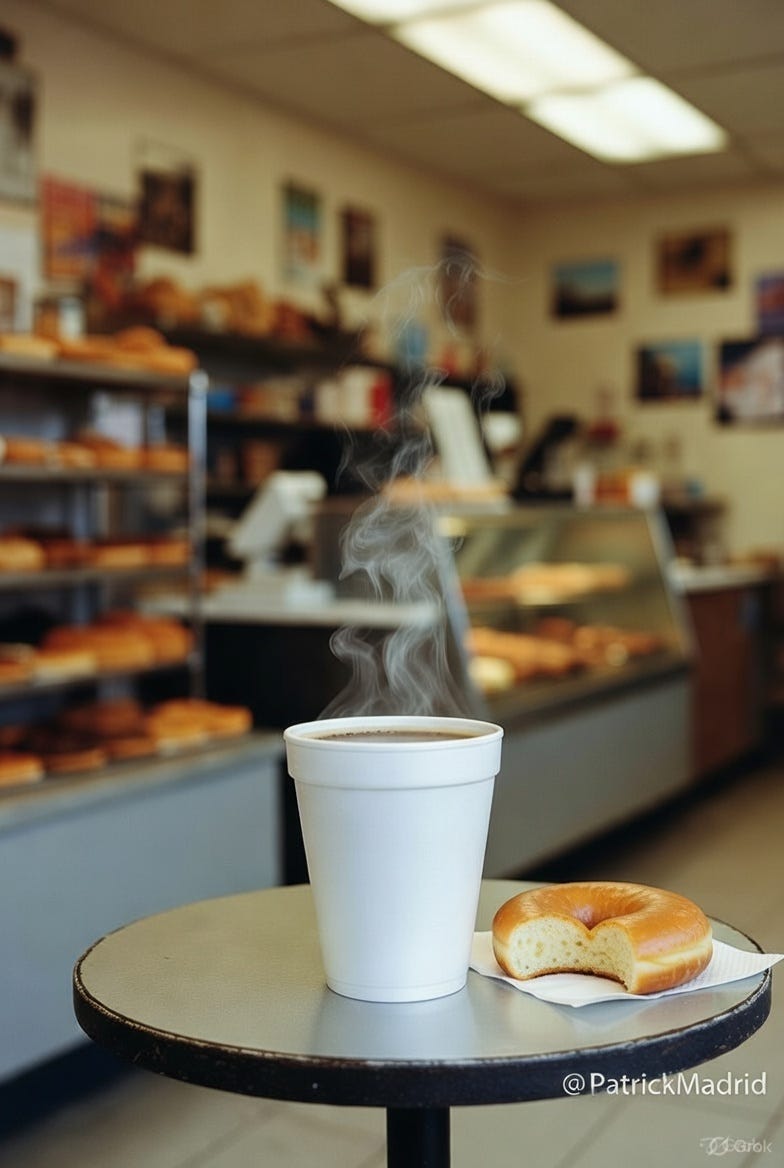
This is worth underscoring, because many Catholics hesitate to talk about the Faith not because they lack conviction, but because they do not know how to begin. They assume evangelization requires bold confrontations or scripted techniques. It usually does not. Often, it begins with presence rather than pressure.
A book can do the heavy lifting.
Put a Catholic book on a table. In an airport. A coffee shop. A waiting room. It works the way flowers work. Bees and hummingbirds find them without being summoned. In the same way, a visible sign of faith often draws a comment from someone nearby, even a total stranger. And once that comment is made, the conversation has already begun.

It doesn’t have to be any book in particular; it could just as easily be one of mine, such as Why Be Catholic? 10 Answers to a Very Important Question, or some other overtly Catholic title. It doesn’t even have to be a book. It could be an icon or a rosary. The point is not so much the book’s title as much as what it quietly signals: a Catholic who is unashamed. A Catholic who is willing to talk openly about Jesus and answer questions if asked.
You don’t have to go looking for a discussion. You don’t have to approach, much less corner, anyone. They’ll come to you. Not always, but it does happen.
Sometimes, all you have to do is set that Catholic book down, take a sip of coffee, and be ready when someone who notices it asks, out of simple curiosity, “What are you reading?”
At that point, the opportunity has already arrived.
Copyright © 2025 Patrick Madrid. All rights reserved. All text, images, and other original content are the property of the author.
I hope you enjoy my articles here. If so, please tap the Share button above to post any of them on X or Instagram or to send it to someone who might be interested in it. And if you enjoy thoughtful, friendly, faith related content, you’ll appreciate my daily program on Relevant Radio. Listen here or get the free Relevant Radio app.
I am always amazed at your patience and listen regularly to your show even though I am one of those "fundamentalists" you mentioned.
The Catechism and a maple bar is more than plenty to chew on.