

Why Did God Say “I Hate Divorce”?
What the Bible and the Catholic Church Really Teach on Divorce and Remarriage


Deep Dive Podcast Discussion:
DIVORCE AND REMARRIAGE is a widespread problem these days. Many Christians know the pain of divorce, and some have remarried. Not surprisingly, many of them wonder about the spiritual ramifications of their situation.
This topic comes up frequently from callers to my daily radio show. In this article, I share the specific details from the Bible and Catholic teaching that I raise when the issue comes up on the show.
Divorced Christians who’ve never attempted remarriage, or who have received from the Church what is known as an “annulment,” are not the focus here. Rather, it’s Christians who divorce and remarry without going through the annulment process who should heed the danger of their spiritual situation.
The Catholic Church’s teaching on divorce and remarriage is anchored squarely on Christ’s teaching:
“Everyone who divorces his wife and marries another commits adultery (Greek: μοιχεία, moicheia), and he who marries a woman divorced from her husband commits adultery” (Luke 16:18).
“It was also said, ‘Whoever divorces his wife, let him give her a certificate of divorce.’ But I say to you that everyone who divorces his wife, except on the ground of unchastity, makes her an adulteress; and whoever marries a divorced woman commits adultery” (Matthew 5:31–32).
The Catechism says,
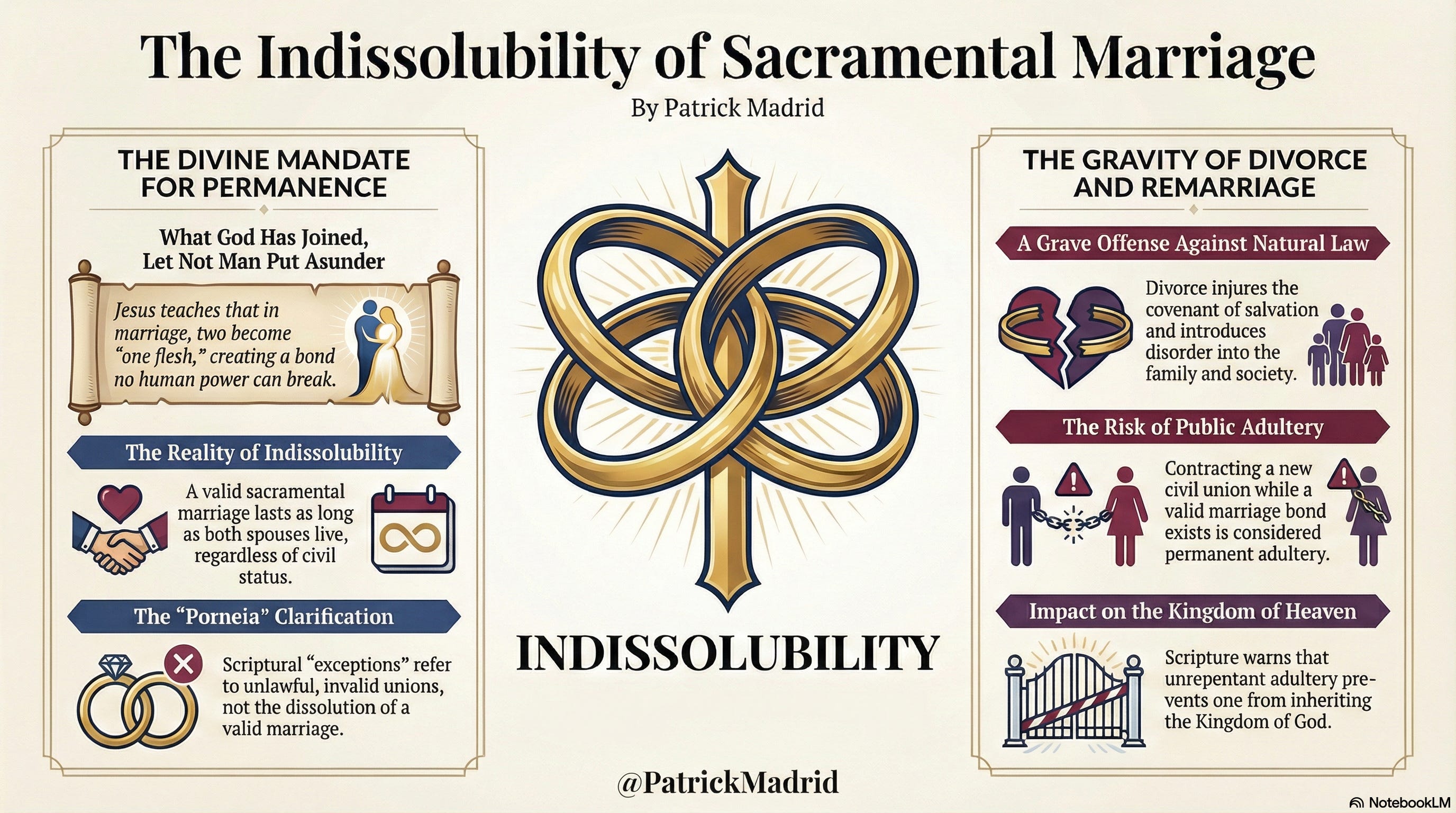
“Divorce is a grave offense against the natural law. It claims to break the contract, to which the spouses freely consented, to live with each other till death. Divorce does injury to the covenant of salvation, of which sacramental marriage is the sign. Contracting a new union, even if it is recognized by civil law, adds to the gravity of the rupture: the remarried spouse is then in a situation of public and permanent adultery” (CCC 2384).
“Divorce is immoral also because it introduces disorder into the family and into society. This disorder brings grave harm to the deserted spouse, to children traumatized by the separation of their parents and often torn between them, and because of its contagious effect which makes it truly a plague on society” (CCC 2385).
“It can happen that one of the spouses is the innocent victim of a divorce decreed by civil law; this spouse therefore has not contravened the moral law. There is a considerable difference between a spouse who has sincerely tried to be faithful to the sacrament of marriage and is unjustly abandoned, and one who through his own grave fault destroys a canonically valid marriage” (CCC 2386).
This is why God said, “I hate divorce . . . so take heed to yourselves and do not be faithless” (Malachi 2:16).
Note that God does not hate people who get divorced, nor does He hate them for getting divorced. He hates divorce itself because of its destructive effects: breaking the marriage contract, separation, pain, chaos, alienation, and the incalculable damage it causes to the husband and wife, their children, extended family, friends, and even to society itself.
When the Rich Young Man asked Christ what he must do to go to heaven, He responded, “If you would enter life, keep the commandments.” Among those he listed was “You shall not commit adultery” (Matthew 19:16–19).
In Matthew 19:3–10:
“Pharisees came up to him and tested him by asking, ‘Is it lawful to divorce one’s wife for any cause?’ He answered, ‘Have you not read that he who made them from the beginning made them male and female, and said, “For this reason a man shall leave his father and mother and be joined to his wife, and the two shall become one flesh”? So they are no longer two but one flesh. What therefore God has joined together, let not man put asunder.’ They said to him, ‘Why then did Moses command one to give a certificate of divorce, and to put her away?’ He said to them, ‘For your hardness of heart Moses allowed you to divorce your wives, but from the beginning it was not so. And I say to you: whoever divorces his wife, except for unchastity, and marries another, commits adultery.’”

Some argue that the phrase “except on the ground of unchastity” constitutes an “exception clause” that allows for divorce and remarriage in cases where one or both spouses commits adultery. But this is a misreading of the text.
The Greek word here for unchastity, porneia (πορνεία),1 refers to sexual unlawfulness precisely because the two “spouses” are not validly married (cf. John 4:17–18), even though they live as if they were. In such cases, to separate and then marry someone else would not constitute adultery, since the two parties were not validly married to begin with.
The Lord was not giving an “exception” for adultery (moicheia), as porneia is sometimes misleadingly rendered into English versions of the Bible. He speaks of the sexual unlawfulness of the union between the man and the woman itself because the arrangement itself is porneia.
King Herod Antipas and his “wife” Herodias make a prime example of this biblical warning against sexual unlawfulness (Matthew 19:9). Even though they “married,” they were not validly married in the eyes of God, which is why St. John the Baptist denounced this sham marriage, declaring, “It is not lawful for you to have your brother’s wife” (Mark 6:18). She was the wife of Herod’s brother Philip.
For his part, St. Paul condemns another sordid situation in which an unnamed Christian man was living as if married with his own father’s wife (1 Corinthians 5:1-5). Similarly, Jesus confronts a “married” woman who was living with a man as if married:
Jesus said to her, “Go, call your husband, and come here.”
The woman answered him, “I have no husband.”
Jesus said to her, “You are right in saying, ‘I have no husband’; for you have had five husbands, and he whom you now have is not your husband; this you said truly.” (John 4:16–18)
A valid marriage, however, cannot be dissolved. As the Lord said:
“And Pharisees came up to him and tested him by asking, ‘Is it lawful to divorce one’s wife for any cause?’ He answered, ‘Have you not read that he who made them from the beginning made them male and female, and said, “For this reason a man shall leave his father and mother and be joined to his wife, and the two shall become one”? So they are no longer two but one. What therefore God has joined together, let not man put asunder.’”
(Matthew 19:3–6)
St. Paul adds:
“[A] married woman is bound by law to her husband as long as he lives; but if her husband dies she is discharged from the law concerning the husband. Accordingly, she will be called an adulteress if she lives with another man while her husband is alive. But if her husband dies she is free from that law, and if she marries another man she is not an adulteress” (Romans 7:2–3).
Anyone who imagines that divorce and remarriage is not serious in God’s eyes should ponder this warning:
“Do you not know that the unrighteous will not inherit the kingdom of God? Do not be deceived; neither the immoral, nor idolaters, nor adulterers, nor sexual perverts, nor thieves, nor the greedy, nor drunkards, nor revilers, nor robbers will inherit the kingdom of God” (1 Cor. 6:9-10).
That passage might trouble someone who is divorced and remarried but who never went through the annulment process and received from the Church a declaration of nullity (i.e., “an annulment”). If so, he or she should feel troubled. His conscience is warning that something is spiritually very wrong.
If you are in this situation, contact a Catholic priest for sacramental confession and to get advice on how to correct things.
Commentary on what “Convalidation” Is and Isn’t from Canon Lawyer Fr. Mark Clarke, C.M.F.
As a professor of canon law and experience of working in a Tribunal, there is confusion, even among clergy, regarding the proper application of convalidation. This is often rooted in the confusion between a defect of canonical form and a lack of canonical form.
Ordinary canonical form is described in Canon 1108 and stipulates that a valid marriage is contracted by a proper member of the clergy and before two witnesses (typically the best man and maid of honor). If grave difficulties hinder the observance of canonical form, the bishop or his delegate has the right of dispensing the Catholic party from the form in individual cases, which we often see for mixed marriages (Can. 1127).
The Church allows a convalidation of a marriage in cases where there was a defect of canonical form. For example, one of the two witnesses lacked the use of reason because he was inebriated and incapable of comprehending the manifestation of consent, or a visiting priest was outside his territory without proper delegation to assist at the wedding. These defects are typically not the fault of the couple.
However, there is no convalidation for a LACK OF CANONICAL FORM.
If a baptized Catholic gets civilly married (a complete lack of canonical form), THERE WAS NO MARRIAGE – that Catholic party is in a CIVIL UNION.
If later, that Catholic party wants to have the marriage “blessed,” they can’t, because there’s NOTHING TO BLESS because there was no marriage. The Church does not bless civil unions!
They will need to have a valid Catholic wedding where they exchange consent following canonical form. This is why we should avoid language that suggests a couple in an invalid marriage because of lack of form can “have their marriage blessed” or convalidated.
We see this commonly in cultures such as Mexico where couples have to have a separate civil marriage ceremony and a “Church” sacramental marriage ceremony, but the “Church” wedding is often delayed until later. Even though they are legally “civilly” married, in the eyes of the Church, this couple is in an invalid civil union that cannot later be convalidated.
If a baptized Catholic gets married by a Justice of the Peace or by a non-Catholic minister without a dispensation, they are not married! They’re in a civil union that’s legally recognized by the state, but not in a marriage recognized by God and the Church.
For baptized Catholics, there is only sacramental marriage.
Additional Bible Verses to Ponder:
“You shall not commit adultery.”
(Exodus 20:14)
“If a man commits adultery with the wife of his neighbor, both the adulterer and the adulteress shall be put to death.”
(Leviticus 20:10)
“You shall not commit adultery.”
(Deuteronomy 5:18)
“He who commits adultery has no sense; he who does it destroys himself.”
(Proverbs 6:32)
“Then I will draw near to you for judgment; I will be a swift witness against the sorcerers, against the adulterers, against those who swear falsely, against those who oppress the hired worker in his wages, the widow and the fatherless, against those who thrust aside the sojourner, and do not fear me, says the Lord of hosts.”
(Malachi 3:5)
“You have heard that it was said, ‘You shall not commit adultery.’ But I say to you that every one who looks at a woman lustfully has already committed adultery with her in his heart.”
(Matthew 5:27–28)
“And he said to them, ‘Whoever divorces his wife and marries another commits adultery against her; and if she divorces her husband and marries another, she commits adultery.’ . . . And as he was setting out on his journey, a man ran up and knelt before him, and asked him, ‘Good Teacher, what must I do to inherit eternal life?’ . . . And Jesus said to him, ‘Why do you call me good? No one is good but God alone. You know the commandments: “Do not kill, Do not commit adultery, Do not steal, Do not bear false witness, Do not defraud, Honor your father and mother.”’”
(Mark 10:11–12, 17–19)
“And Jesus said to him, ‘Why do you call me good? No one is good but God alone. You know the commandments: “Do not commit adultery, Do not kill, Do not steal, Do not bear false witness, Honor your father and mother.”’”
(Luke 18:19–20)
“You who say that one must not commit adultery, do you commit adultery? . . . Owe no one anything, except to love one another; for he who loves his neighbor has fulfilled the law. The commandments, ‘You shall not commit adultery, You shall not kill, You shall not steal, You shall not covet,’ and any other commandment, are summed up in this sentence, ‘You shall love your neighbor as yourself.’”
(Romans 2:22; 13:8–10)
“To the married I give charge, not I but the Lord, that the wife should not separate from her husband (but if she does, let her remain single or else be reconciled to her husband) and that the husband should not divorce his wife.”
(1 Corinthians 7:10–11)
“Let marriage be held in honor among all, and let the marriage bed be undefiled; for God will judge the immoral and adulterous.”
(Hebrews 13:4)
Related teachings in the Catechism of the Catholic Church:
“Given the failure of the marriage, the Church must determine whether the marriage ever existed. If that is not the case, the contracting parties are free to marry, provided the natural obligations of a previous union are discharged.”
(CCC 1629)
“In case of a mixed marriage . . . the couple is obliged to maintain unity and indissolubility of marriage.”
(CCC 1634)
“The separation of spouses while maintaining the marriage bond can be legitimate in certain cases . . . If civil divorce remains the only possible way of ensuring certain legal rights, the care of the children, or the protection of inheritance, it can be tolerated.”
(CCC 1649)
“The Christian home is the place where children receive the first proclamation of the faith . . . Family life is an initiation into life in society.”
(CCC 1651, concluding paragraph)
“Divorce is immoral also because it introduces disorder into the family and into society . . . it truly becomes a plague on society.”
(CCC 2385)
“It can happen that one of the spouses is the innocent victim of a divorce decreed by civil law . . . there is a considerable difference between a spouse who has sincerely tried to be faithful to the sacrament of marriage and is unjustly abandoned, and one who through his own grave fault destroys a canonically valid marriage.”
(CCC 2386)
Helpful Resources on Marriage, Divorce, and Annulments:
• Primal Loss: The Now-Adult Children of Divorce Speak (Leila Miller, 2018, LCRM Publishing) — ISBN: 9780997989311
• Annulments and the Catholic Church: Straight Answers to Tough Questions (Edward N. Peters, Ascension Press) — ISBN: 9781932645002
Amazon listing for Annulments and the Catholic Church (Edward N. Peters)
• Excommunication and the Catholic Church: Straight Answers to Tough Questions (Edward N. Peters, Ascension Press) — ISBN: 9781932645454
Amazon listing for Excommunication and the Catholic Church (Edward N. Peters)
• When Is Marriage Null?: Guide to the Grounds of Matrimonial Nullity (Paolo Bianchi) — ISBN: 9781586177990
Amazon listing for When Is Marriage Null? (Paolo Bianchi)
• Marriage: The Mystery of Faithful Love (Dietrich von Hildebrand, Sophia Institute Press) — ISBN: 9780918477002
Amazon listing for Marriage: The Mystery of Faithful Love (Dietrich von Hildebrand)
• The ABCs of Choosing a Good Husband: How to Find and Marry a Great Guy (Stephen Wood, Family Life Center Publications) — ISBN: 9780972758308
• The ABCs of Choosing a Good Wife (Stephen Wood, Family Life Center Publications) — ISBN: 9780972758339
• Three to Get Married (Fulton J. Sheen, Scepter Publishers) — ISBN: 9780933932871
• Retrouvaille (helpourmarriage.org)
AI Summary: “Retrouvaille (French: “rediscovery” or “finding one another again.”) is a confidential Catholic program designed for married couples who are struggling, feeling distant, or nearing separation or divorce. It provides a structured weekend experience and follow-up sessions that help spouses rebuild communication, restore trust, and rediscover their marriage. Open to all couples regardless of church attendance, and especially helpful when conventional counseling has stalled. Learn more at: https://helpourmarriage.org”
• Mary’s Advocates (https://marysadvocates.org)
AI Summary: “A Catholic nonprofit that promotes the permanence of marriage, supports spouses facing civil divorce, and encourages the use of Canon Law and reconciliation-focused approaches consistent with Catholic teaching.”
• Canon Law Made Easy (https://canonlawmadeeasy.com/tag/annulment/)
AI Summary: Explains Catholic canon law in clear, lay-friendly language. Its annulment section answers common questions about marriage validity, tribunal procedures, grounds for nullity, and misconceptions about annulments versus so-called “Catholic divorce.”
For other instances of pornea (πορνεία) in the New Testament, see: Matthew 5:32; Matthew 15:19; Matthew 19:9; Mark 7:21; John 8:41; Acts 15:20; Acts 15:29; Acts 21:25; 1 Corinthians 5:1; 1 Corinthians 6:13; 1 Corinthians 6:18; 1 Corinthians 7:2; 2 Corinthians 12:21; Galatians 5:19; Ephesians 5:3; Colossians 3:5; 1 Thessalonians 4:3; Revelation 2:21; Revelation 9:21; Revelation 14:8; Revelation 17:2; Revelation 17:4; Revelation 18:3; Revelation 19:2.
Copyright © 2003-2026 Patrick Madrid. All rights reserved. Adapted and expanded from my 2003 article “What Does the Catholic Church Teach About Divorce and Remarriage?” All text, images, and other original content are the property of the author.
I hope you enjoy my articles here. If so, please tap the Share button above to post any of them on X or Instagram or to send it to someone who might be interested in it. And if you enjoy thoughtful, friendly, faith related content, you’ll appreciate my daily program on Relevant Radio. Listen here or get the free Relevant Radio app.

Patrick, Thank you for posting this comprehensive article on a most difficult subject. Many of us wish we would have learned these facts earlier in our lives. God bless & peace, Jeff
Thanks be to Jesus Christ, for inspiring Church Authorities to establish the Tribunal. Having been divorced, I had been sure we were Sacramentally united, but I did not have the authority, or expertise, to be sure. So, I went to Tribunal. Writing the Narrative was hard because, most of the time, I am the resident 'expert' on 'Catholic', and I assumed the Judges would be more so. They agreed to Nullity. Judge admitted, if there was lack of Sacramentality, it did not come from me. My wife refused to participate. Did Tribunal get it right? Should I have appealed to Rome? Before the decision, I told Jesus I would abide by the Tribunal's decision, and I have. Since remarried, and delighted beyond my wildest imagination. My wife, now, her ex-husband died, the same day I had prayed "Is this ok, Jesus"? So. Whoever, particularly unwillingly (he, or she, "kicked you out") finds themselves divorced, please take your case to Tribunal. You need to know, for sure, if you are free, in Christ, to remarry. If you are not, it is a spiritually lethal mistake to remarry. Have recourse to the Authority Jesus supplies. Pray for willingness, to obey the decision. Know that you can appeal to Rome, if you disagree with it.